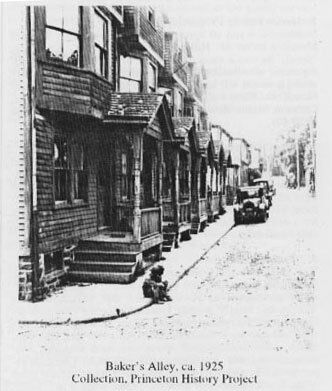
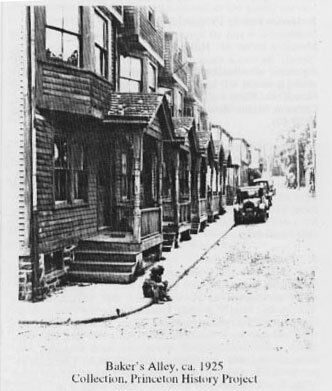
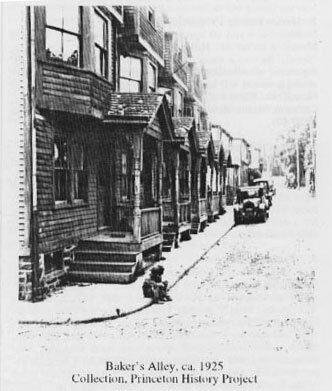
The residents of Baker Street, who were mainly working class families, were forced to move in 1929 from the area where Palmer Square was eventually built. (Photo courtesy of Shirley Satterfield.)
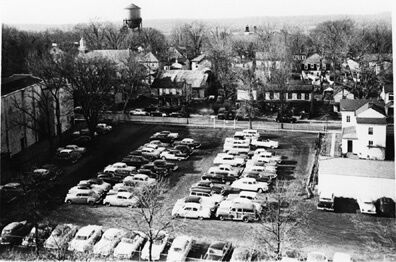
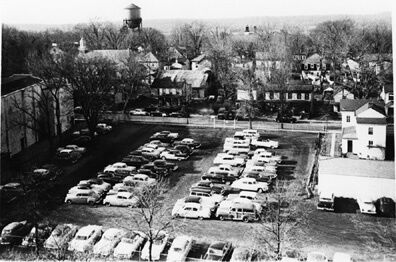
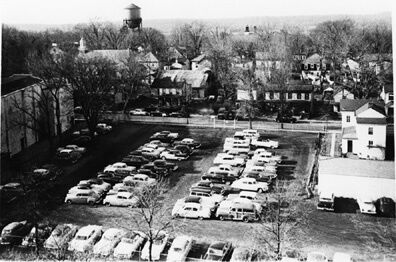
Pictured is an aerial view of Jackson Street and the parking lot for the Playhouse Theater. The street and its homes were replaced with million-dollar townhouses along what is now Paul Robeson Place. (Photo courtesy of Henry Pannell.)
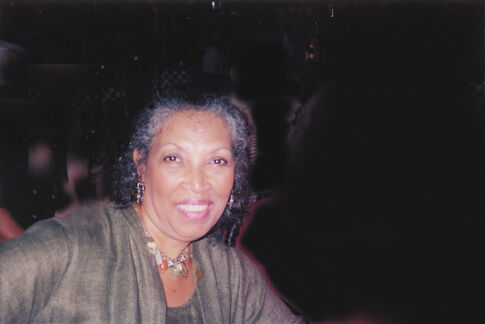
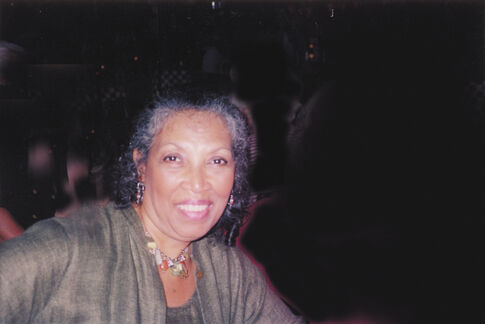
Undated file photo of Shirley Satterfield.
Henry Pannell grew up on what was formerly Jackson Street, in the part of Princeton Borough that took care of the rest of town.
The Witherspoon Jackson community, named after its border streets, has been known for generations as the working class section of Princeton. Its residential streets have been home to laborers and domestic workers, many of whom were employed at local restaurants around town and at the Princeton University eating clubs.
Pannell and fellow Witherspoon Jackson native Shirley Satterfield have strived for years to document the neighborhood’s African-American history in Princeton, as the community’s population has continued to change since Pannell and Satterfield grew up in the 1940s and ’50s.
The community, which was home not just to African-Americans, but also to Italian and Irish families, was home to mostly poor families, though there are several noteworthy individuals—among them Andrew Hatcher, associate press secretary for JFK; Bruce White, a New York Supreme Court justice; Dr. Robert Rivers, a surgeon who eventually became a trustee at Princeton University; and Dr. Henry J. Austin, after whom the Henry J. Austin Health Center in Trenton was named—who were also products of the community.
The neighborhood was self sustaining, with local shops and eateries—such as ice cream parlors, barbershops and even grocery stores—often run out of residents’ private homes. Entertainment for residents consisted of church on Sundays and time spent at the “colored Y,” located in the building that has since been modernized and now houses the Arts Council of Princeton.
Satterfield, who grew up on “old” Clay Street—before its original homes were knocked down and new ones rebuilt in 1952—and later moved with her family to Birch Avenue to live with her aunt and uncle, said her grandmother always kept a pot of beans cooking on the stove for any visitors who stopped by—which they often did.
“There used to be a time when the only time we really saw white people in this neighborhood, other than the Italian and Irish people who lived in this community, was when they came to pick up the people who worked for them or to go to the hospital,” she said.
But the neighborhood has seen many changes over the years. As Princeton’s population continues to grow, the Witherspoon Jackson community has fast become one of the last places in town where less affluent families can afford to live. And now, even that’s changing, as some buyers have purchased homes only to tear them down and build new, more expensive residences, raising property values on the surrounding homes.
As the expenses increase in the neighborhood once reserved for the working class, residents’ descendents are unable to return to the place where they grew up, Satterfield said.
But displacement of working class families is nothing new in Princeton. Duplex homes located on a section of Birch Avenue are some of the oldest examples of the displacement of African-Americans and working class families. The homes were uprooted from their original location in 1929 to make way for the construction of Palmer Square.
Many low-income families were forced to move out of the section of town then known as Baker Street, often referred to as Baker Alley, which had been lined with row homes. The homes were divided in sections of two, and were rolled down the street on logs to be placed on Birch Avenue, where they still stand today.
The relocation, however, necessitated a longer walk to Nassau Street for the residents, many of whom worked at Princeton University. Even Jackson Street, where Pannell’s childhood home once stood, no longer exists. The area is now the site of million-dollar townhouses along Paul Robeson Place.
* * *
The Witherspoon Jackson community had been self-sustaining largely out of necessity, Satterfield said. African-Americans were not welcome in such famed Princeton establishments as the now-closed Lahiere’s French restaurant and the popular Baltimore Dairy Lunch, nicknamed “The Balt.”
Pannell recalled how he and his friends would get nickels from their parents to buy candy and pretzels at a local store after school. The integration of the schools didn’t stop the kids from wanting to satisfy that sweet tooth. They walked into a candy store on Nassau Street by their new elementary school, a business owned by an older white man, located where Thomas Sweet is today.
“We went in there, and he said, ‘what you n*****s want in here?’” Pannell said. “That’s what went on. Princeton was really segregated. All of the stores uptown, most of them you couldn’t go in. Our mother used to take us up to Woolworths, but I know she was uncomfortable in there.”
The realization that she was being treated differently came to Satterfield with the integration of the Princeton Borough schools in 1948—called the “Princeton Plan”—when she left the Witherspoon School for Colored Children to attend third grade at the integrated Nassau Street School. (The Witherspoon School for Colored Children was renamed Witherspoon School and was converted into an integrated junior high.)
Satterfield recalls African-American students being told they weren’t “college material,” and that even if they did manage to progress to higher education, they’d only receive training as secretaries or teachers. Satterfield, who went on to become a teacher and guidance counselor, said meetings with her own Princeton High School guidance counselor were nonexistent. It was through the community and their churches that children from the working class section of town were able to go on to college.
One music teacher even ordered Pannell, in seventh grade, to sing “Shortnin’ Bread,” a racist tune from the time of slavery. Pannell wound up in the principal’s office because of his response to the teacher.
“It wasn’t the kids,” he said. “We got along with the kids. I can’t remember having a bad episode with the white kids in school. But the teachers…”
Third grade was the last year Pannell spent at the “colored” elementary school. He said it was also the last time he received a real education from caring teachers.
“I really feel as though I really got cheated,” Pannell said. “We went to Nassau Street School, and there my learning stopped. Because the teachers didn’t give a damn about you. We sat in the back of the classroom and competed with each other.”
Today, Satterfield said, many people still don’t realize the extent of racism African-Americans in Princeton felt.
“I take people on tours who have lived in Princeton … who’ve never even been in this community,” Satterfield said. “They don’t even know anything about segregation in Princeton. It’s an eye opener.”
Satterfield left Princeton after a year of secretarial studies at Rider College, which was then located in Trenton—where she quickly realized she hated shorthand—to attend Bennett College for Women. She spent several years teaching around the U.S., and later became a guidance counselor, but had never planned to return to the neighborhood where she grew up.
But Satterfield eventually did come back to Princeton, moving to the home on Quarry Street where she still lives today. She developed an attachment to the history of the town where she had grown up and became a member of the Princeton Historical Society, only to find little documentation on the history of many ethnic groups in Princeton. Tours of the historic Nassau Street and former Princeton Borough area had actually stopped at the entrance to the Witherspoon Jackson community before Satterfield established a tour that focused on Princeton’s African-American history.
The struggle now is not just to maintain the history of the working class community—it’s to preserve it, and Satterfield and Pannell have remained at the forefront of those efforts.
In the 1970s-1990s, the Witherspoon Jackson Development Corporation was formed by residents to combat the number of homes being sold. The group purchased 23 homes with financing from the bank, and assisted residents’ descendants with moving into the homes so they could return to their childhood community.
Now, regular Witherspoon Jackson community meetings are held to discuss any issues in town that could affect the neighborhood.
But much of the effort has also included the preservation of stories, memories, experiences and memorabilia of the place many working class individuals still call home.
Pannell, who retired five years ago after 29 years working for the Princeton Borough Housing Authority, has spent the past several years recording dozens of video interviews with past and present Witherspoon Jackson residents about their experiences in the community. The interviews are kept on record with the Princeton Historical Society and Princeton Public Library.
Despite their work to preserve the neighborhood, Satterfield and Pannell fear it will eventually lose its diversity, as the pair sees no obvious successors to take on the cause.
What they hope is to one day have the neighborhood declared as an official historic area, Satterfield said.
“We should get the same respect in this neighborhood that they get on Westcott or Library Place,” she said, “that when anytime anybody moves, whether it’s the western section or moving here, people should know the history of their community.”
,
,
,