The Ewing Environmental Commission choose the Norway Spruce as the February Tree of the Month and the Blue Atlas Cedar for March.
Norway Spruce, Picea abies, has a formal, pyramidal shape and is usually dense and attractive even in its mature years.
The needles measure a half to 1 inch long and are bright green when young changing to dark, shiny green as it ages. The cylindrical cones, are 4 to 6 inches long and hang down from the branches.
The growth rate is medium to fast and the tree can reach 100 feet high, although a height of 40 to 60 feet and a spread of 25-30 feet are more common. The branch ends in older trees become pendulous.
Norway Spruce has a shallow, spreading root system and prefers moderately moist, well drained, acid soils. Most average soils will sustain this tree if moisture is sufficient. Full sun is necessary. Norway spruce is deer resistant.
Many experts feel that Norway spruce is over-used as it may lose its shape and usefulness in old age. Crowding the trees causes shaded branches to die out. They are used extensively as windbreaks or hedges and make beautiful ornamental specimens on large properties when young.
Spruce wood is strong and important in the manufacture of paper and pulp; rope is produced from the fibrous roots. The pitch is used for medicinal purposes and varnishes, and spruce beer, which once was thought to cure rickets, is made from the new, leafy shoots. Spruces are popular as Christmas trees.
Many people have difficulty distinguishing spruce trees from fir trees. A good method for novices is to rub a needle between the thumb and fore-finger, if the needle is flat (F) it is a fir; if it seems square (S) it is a spruce.
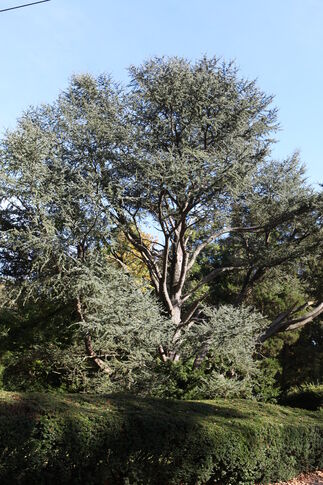
The Blue Atlas Cedar, Cedrus atlantica, is a widely pyramidal, needled evergreen is native to Northern Africa, specifically the upper slopes of the Atlas mountains of Algeria and Morocco. Our featured tree makes its home off Wilburtha Road.
Introduced to this country before 1840, the Blue Atlas Cedar thrives in USDA Hardiness zones 6 to 9, Ewing is in USDA Zone 6B).
It can grow to 120 feet tall and 100 feet in spread, but 40’ to 60’ high with a spread of 30’ to 40’ is more common.
The spirally arranged needles are .5” to 1” in length, and vary from bluish green to light green, and the variety ‘Glauca’ is notably blue and common in our area. The cones, which take about two years to mature, are small and green at first, reaching about 3” long, brown, and upright on the branch. There is also a pendulous (weeping) variety.
The Blue Atlas Cedar prefers a well-drained, moist, loamy soil but will tolerate other soils if moisture does not stagnate. Said to be deer resistant, it thrives in full sun and should be sheltered from heavy winds. Weevils, aphids, scale, root rot and blight occasionally affect it. A stately and beautiful tree, Blue Atlas Cedar should be used as an ornamental specimen.
The wood is durable and can be used for building, furniture, and veneers. Extracts of the tree oils are used for a variety of medical conditions, perfumery, and as an insect repellent.
The Ewing Environmental Commission (eec@ewingnj.org) welcomes suggestions for the Tree of the Month from all Ewing residents.
,

