P.A.L.E. A.L.E.S. club has helped many get started in their home brewing hobby
Porter is a beer style that can be found at many bars and restaurants today, but only a decade ago the dark, malty style was a rare find on tap.
Most drinkers preferred pale lagers and light beers to the roasted, bitter flavor of a porter. But Andrew and Laurie Koontz were among those who liked the style’s added complexity and fuller flavor. Since it was hard to come by, they decided to brew it themselves. That was in 1995.
The Koontzes had climbed aboard the home brewing train early, but they were by no means alone in the area. That same year, Joe Bair founded P.A.L.E. A.L.E.S., the Princeton And Local Environs Ale and Lager Enjoyment Society. Bair was and is the proprietor of Princeton Homebrew, which today can be found in Trenton off Route 29, and for the last couple decades he has served as a sort of beer guru for hundreds of hobbyists.
In 1995, Bair’s store was right on Nassau Street in Princeton, not far from where the Koontzes had an apartment, and he was the one to sell them their first beer kit. After he began seeing them at the store regularly, he told them about the club and said they might like to join, which they did. Eighteen years later, they are still members.
PALE ALES — from here on we’ll leave out those cumbersome periods — is a Mercer County-based club for home brewers. They have monthly meetings, usually held in an area brewpub or a bar that caters to beer lovers. The February meeting was held at Triumph in New Hope, Pa.
Guest speakers might be representatives from a local beer distributor or professional brewers, on hand to talk about the industry in general and the beers they represent in particular. They might also happen to have in tow some samples for members to try.
It costs $30 a year to join, and family memberships are available for $45. Besides the monthly meetings, PALE ALES hosts workshops on brewing techniques, an annual home brewing competition, and other events, like the Big Brew, which is a national event coordinated by the American Homebrewers Association.
This year the annual competition is scheduled to be held March 17, a day that is no stranger to beer. Members of the club don’t have to compete, but if they’ve recently made some beer that they think has sufficient quality, they might submit one or even a few brews to be judged.
Certified judges are brought in to choose the winners, but brewers also get spoken or even written feedback from the other members of the club who try their beer.
“The beer contest is a lot of fun,” said Vince Feminella, 61. “It’s usually a Sunday afternoon, brewers drinking getting together, drinking home brew. Even if I don’t win, I get good feedback and we have a great time.”
Members also get a discount at Bair’s store, and it’s usually through the store that members learn about the club, although there is a website, paleales.org, that features a blog, club calendar and photos from past events.
While members say they find the meetings and services valuable, they’re hardly the only reasons, or even the main reasons, for joining the club. As much as anything PALE ALES is a social club, where people meet other people like themselves, share the fruit of their labor, and generally have a good time.
* * *
Vince Feminella hasn’t been brewing for decades, but the Hamilton resident has been making up for lost time.
Feminella, a computer programmer by day, had never made beer before 2010, when his wife gave him Mr. Beer as a gift. Mr. Beer is the brand name of a popular home brewing kit that first hit the market in 1993.
Not that long ago, Feminella was perfectly happy drinking popular mass-market brews, listing Pabst Blue Ribbon, Rolling Rock and Yuengling, all pale lagers, among his old favorites.
But it’s fair to say that once he gave kit brewing a try, he was hooked. He completed that first batch and 87 others within a year, all using the Mr. Beer brewing kit. He was even named Home Brewer of the Month on the Mr. Beer website.
Kits simplify the brewing process down to a few steps and ingredients. It’s a little like making pancakes from a mix rather than from scratch.
“Water, syrup, yeast—seal it up three weeks, and after three weeks you’ve got beer,” Feminella said.
Kits are disdained by many experienced brewers. But they are the gateway into brewing for many hobbyists today, and while all of the home brewers I spoke to have graduated to all-grain brewing—using malted barley, hops, yeast and water—they all started with kits.
“Compared to all-grain brewing, [kits are] relatively easy,” Koontz said. “You can have an early success. That’s sort of the key to a lot of things: you’re able to do something and it goes well. [With all grain] you can get in over your head, and it goes terrible.”
After a while, Feminella began to come up against the limitations inherent in kit brewing. He wanted to do certain things to make his beer taste better that were impossible using premixed formulas and extracts. Almost inevitably, he made his way to Princeton Homebrew.
“I was so nervous first time I walked into a homebrew shop,” Feminella said. “People, as soon as they hear Mr. Beer they’re like, ‘You’re not brewing beer.’”
But Bair has been coaching brewers up the ladder for years. Although home brewing is more popular than ever, he still owns one of the few places in the area where people can get beermaking equipment or ingredients, and he knows how to encourage brewers to take their next steps.
Today Feminella goes all out. He has renovated the basement of his home near Steinert High School to feature a brew kitchen, replete with a stove, sink, fridge and tables, plates for growing yeast and an exhaust system for venting fumes, which are a must for those who want to do all-grain brewing indoors.
Feminella even made his own burner frames out of aluminum tubing, for more direct heat. He made his first stout two years ago, and he remembers after that making a witbier that tasted good. From there he started making India Pale Ales. Instead of getting a yield of one case, like a kit provides, Feminella and other all-grain brewers are often working with 5- or 10-gallon batches.
Most home brewers end up sharing a lot of their beer with family and friends. Vince’s son Eric says every time his dad brews a new batch is “sort of like Christmas.”
“You know it’s going to be good, but you just don’t know what it’s going to be,” he said. “Whenever he brews it’s cool because it’s a surprise.”
* * *
“The joy of home brewing has always been to create beers that were either expensive to purchase or to create some beers that sort of existed historically but weren’t available commercially,” says Andrew Koontz.
He and his wife Laurie often brew together, which is somewhat unusual. Men have tended to dominate the brewing industry, although as craft beer grows in popularity, more women are brewing beer than ever before.
“Generally, one half of the couple [brews beer] and the other can’t stand it or something,” Koontz said. “But no, we’re not like that. It’s something we’ve always enjoyed doing together. My wife likes beer too, and that’s slightly unusual.”
He said they took it one step at a time at first, The first beer they brewed was that porter, and they thought it turned out well.
“So we tried some other things and eventually branched out,” said Koontz, 45, who is a member of the Mercer County Board of Chosen Freeholders.
Today the Koontzes live in a house instead of an apartment, still in Princeton, but even though Andrew sheepishly admits that home brewing was a consideration when they searched for their house, they don’t brew as often as they once did. When they do brew it tends to be in the summer, so they can work outdoors using a Cajun cooker. Many home brewers work only in warm weather so they can be outside, where exhaust is not an issue.
The Koontzes don’t intend to submit a beer for this year’s competition, but they are looking forward to it all the same.
“I really like to see newer members compete,” Koontz said. “I competed a bunch years ago, and won a couple ribbons, and that’s great. But I want to see how other folks do.”
As a long-term member Koontz has observed the club growing in popularity over the years.
“There’s a generation of some younger brewers who have joined up,” Koontz said. “It’s really exciting to see that kind of thing happen. It’s kind of like the older members in the club are now guys in their 40s and over, and the there’s a number of folks in their 20s and 30s, which, I guess looking back to 1995, that’s what I was.”
Jeff Samuels is one of those new members. Though he’s been brewing for more than a decade, the Ewing resident only joined PALE ALES at the end of 2012.
At 53, Samuels is a little older than some of the new members Koontz was talking about. But he has found it rewarding and enriching all the same.
He said that while some PALE ALES members have better technical understanding of brewing than he does, they tend to be friendly guys, willing to share recipes and advice.
“My fear when I joined the club was it would be a bunch of beer snobs, and it wasn’t that way,” Samuels said. “They’re regular guys. It’s a real comfortable atmosphere.”
* * *
The Beer Institute, a national trade association for the brewing industry, announced in December that there were more breweries (2,751) operating in the U.S. in 2012 than any time since 1887, which is as far back as their information goes.
Large brewing companies that make well-known brands like Budweiser, Miller, Beck’s and Guinness account for the vast majority of beer brewed in the U.S., or indeed the world. But most of the 2,751 are classified as microbreweries, producing not millions but thousands or hundreds of barrels a year.
Many of these small-scale commercial brewing operations count former home brewers on their staffs, and every year more home brewers start microbreweries and brewpubs of their own. Since 2011, four new breweries have opened in New Jersey: Kane Brewing Company in Ocean Township, Carton Brewing Company in Atlantic Highlands, Cape May Brewing Company in Cape May, Flounder Brewing Company in Hillsborough. In Pennsylvania, Neshaminy Brewing Company (Croydon), Vault Brewing Company (Yardley) and the Forest and Main brewpub (Ambler) have all opened during that time.
But for some brewers, like the Koontzes, like Vince Feminella and Jeff Samuels and many others who belong to PALE ALES, the privilege and challenge of making beer at home is reward enough.
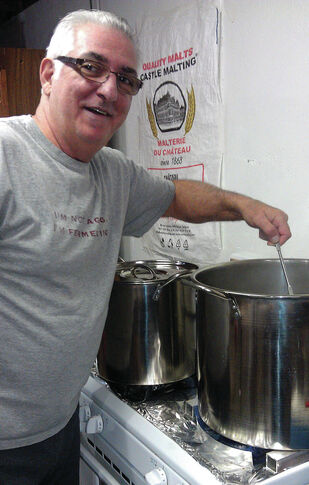
Vince Feminella brews up a batch of homemade beer in his home in Hamilton in this undated photo.,

