John Bencivengo adjusted the microphone.
He had stepped to the center of Courtroom 4W in the Clarkson S. Fisher U.S. Courthouse in Trenton, about to read a statement. He fixed the mic, looked down and began to read, softly.
“Let me begin by saying, ‘I’m sorry,’” he said.
Thousands of words had been spoken in the courtroom during the federal case against the former mayor of Hamilton Township, hours of discussions about influence, insurance brokers and cherry bedroom sets. Four months had gone by since a jury found him guilty of five counts—extortion under color of official right, attempted extortion under color of official right, two counts of violating the federal Travel Act and money laundering.
But here, at Bencivengo’s March 13 sentencing, was something new. It was the first time Bencivengo—or anyone—had said “sorry.”
Bencivengo took full responsibility for his actions March 13, saying they have been a cause of personal remorse, anxiety and self-torture. U.S. District Judge Anne E. Thompson agreed with Bencivengo’s statement of culpability, sentencing him to 38 months in prison and a $3,000 fine. He must also repay a portion of the $12,400 in bribes he accepted from Marliese Ljuba, the former Hamilton school district insurance broker and the government’s star witness in the case. The FBI will receive $7,400 from Bencivengo.
Bencivengo, 59, also will be subject to three years of supervised release after his prison term. He can no longer hold public office.
Attorney Jerome Ballarotto said he and Bencivengo will discuss whether they want to appeal the decision. For now, Bencivengo must report to serve his sentence by April 29.
The former mayor requested to be placed in a facility close to Hamilton so he could see family, namely his 90-year-old mother. He credited her for giving him strength during the trial, and said he wants to be able to see her while he can.
* * *
Ballarotto took plenty of avenues in an attempt to defend his client from the 78-month jail sentence the federal government sought for Bencivengo, and he went to one more often than the rest. He wanted to paint Bencivengo as an unwitting criminal, someone who didn’t know what he was doing and had ruined his own life in the process.
Thompson received 60 letters from Bencivengo family members and friends, attesting to the former mayor’s character. The judge said she read every one, calling one she received from Bencivengo “thoughtful.”
Ballarotto revealed Bencivengo has been battling depression for 12 years, and lined up a clinical psychologist, Gerald Cooke, to testify about the potential effects of depression on a person’s ability to make decisions.
Cooke said he met with Bencivengo for three-and-a-half hours Jan. 4 to conduct a clinical interview and a battery of tests. He reviewed Bencivengo’s background history, his medical records and the government’s indictment. As the attorney questioned the psychologist, Ballarotto released previously unknown information about Bencivengo, clearly intended to build sympathy.
Cooke said his discussion with Bencivengo mainly centered around three relationships: with his now ex-wife, with Lauren Auletta—a 20-something township employee who had an on-and-off romantic relationship with the mayor—and with Ljuba, a friend who Bencivengo went to for support. Each of these relationships contributed to Bencivengo’s emotional instability in their own way, Cooke said.
But none of them caused the initial problem. Bencivengo was treated for depression first in 2001, and had been taking the prescription drug Celexa. Then, in 2008, Bencivengo’s depression worsened, and his doctor switched him to Lexapro. Both drugs are used to treat major depression.
They allegedly weren’t enough. According to Cooke’s testimony, Bencivengo suffered an acute breakdown on Jan. 6, 2012, an episode where he cried uncontrollably. His therapist diagnosed him with major depressive disorder, basically reaffirming the previous depression diagnoses.
In May 2012, Bencivengo began seeing a court-appointed therapist. This doctor came to the same conclusion: the former mayor was severely depressed.
Cooke said people in this state tend to dwell on their problems and aren’t as attuned to what goes on around them. Ballarotto used that information to suggest Bencivengo was depressed, distracted and unable to process the implications of the conversations he was having with Ljuba about the bribes. He was “impaired,” the attorney said.
After Cooke’s testimony, Stacie Bencivengo—the mayor’s daughter—and Bencivengo himself gave statements about how trying life has been in recent years, particularly since the government allegations surfaced. Both speakers broke down in tears.
Stacie Bencivengo said her father admitted to her that he used poor judgement in this case, and that she has seen him endure great pain. She called the repercussions of the trial—the loss of job, money, reputation and friends—a “life sentence.”
Bencivengo, meanwhile, struck a contrite tone. He thanked his family for support. He promised to devote his life after jail to helping others. He ended his tearful statement by apologizing to Thompson, adding he was profoundly sorry this matter was even before her.
The statements from the two Bencivengos, Cooke’s testimony and the 60 letters seemed to have some effect. Just before issuing her ruling, Thompson warned the guidelines are not mandatory and “human factors” can affect the sentencing.
But she had enough when Ballarotto suggested Bencivengo “never violated the trust of the people of Hamilton Township as mayor” and was convicted for offering advice, not for unduly influencing school board business in exchange for cash.
“You cannot escape the fact he was the mayor of a very large township,” Thompson said. “That is a very important post.”
Then, she took one final dig at Bencivengo before issuing his sentence.
“It was almost as if he was a neophyte or an amateur who became mayor without the foundation of integrity or strong principles he needed to hold that high office,” Thompson said.
* * *
U.S. Attorney Harvey Bartle patiently waited while the defense painted Bencivengo as someone who had been duped.
And when Bartle finally got his chance, he pounced on Ballarotto’s argument.
What about the $5,000 check made out to Tracy Warney, the wife of Rob Warney, the township’s director of community planning and a friend of Bencivengo’s? What about the way Rob Warney paid Bencivengo the $5,000 in small increments, not to draw attention? And, finally, what about the memo on that check, the one that read, “Cherry bedroom set”?
Why would they ever need to have a memo like that when only an entity like the FBI could ever access the check after it had been deposited? Bencivengo had been part of a plan to conceal the money and its true purpose, Bartle argued, and the whole thing “reeks of criminality.”
“They were concerned from the beginning,” he said.
Bartle then pointed to trial testimony that showed Rob Warney had told Bencivengo previously about Ljuba’s bribes, and Bencivengo was the one who asked Warney to arrange something similar for him. The U.S. Attorney went further to prove Bencivengo wasn’t tricked. He knew what he was doing, and if he had been so upstanding, he only had to say one word to Ljuba prevent his legal problems, “No.”
“The people of Hamilton Township are entitled to influence-free government,” Bartle said, “It’s their right. And Mr. Bencivengo violated it.”
* * *
Bartle had the last word before Thompson deliberated. But Ballarotto anticipated the prosecution’s rejection of his heartstrings argument and also tried to take procedural measures to limit the length of Bencivengo’s sentence. Among other things, he argued Bencivengo only received one continuing bribe, not the two the prosecution had argued the ex-mayor took.
The difference matters because the courts use a point system to help determine a convicted person’s offense level, and the offense level dictates that person’s sentence. More points usually mean a stricter sentence, and Bencivengo went just over the threshold in several areas that added to his offense level.
Being a public official landed him with 14 points. Taking more than one bribe added two points to the charges. Accepting more than $10,000 in bribes earned Bencivengo a four-point bonus.
The defense proposed an offense level of 18, which court guidelines dictate deserves a prison sentence of 27-33 months. The government wanted Bencivengo to receive an offense level of 26, which guidelines say comes with a sentence of 63-78 months in prison. In the end, Bencivengo wound up receiving a little of both—the government’s preferred offense level of 26, but a sentence closer to the range offered by Ballarotto.
Thompson’s official sentence for Bencivengo was 38 months in prison for each of the five counts against him, the terms to be served concurrently.
After handing down the sentence, Thompson and the attorneys took care of some details. Then, the judge stepped off the bench and left the courtroom.
* * *
After the hearing, Bencivengo waited with a bailiff in the lobby outside Courtroom 4W. The people who filled the courtroom—Bencivengo supporters and township gadflies, law students and media members—filed out into the same lobby.
The reporters, seeing the mayor basically alone, approached him. The bailiff stepped in front of the mayor and put his hand out.
“He has some things to take care of,” the bailiff said. “He can talk to you outside.”
An elevator arrived, and Bencivengo and the bailiff stepped inside.
Bencivengo offered a cheek-to-cheek smile to the reporters, looking a bit like the Cheshire Cat as he disappeared behind the closing elevator doors.
* * *
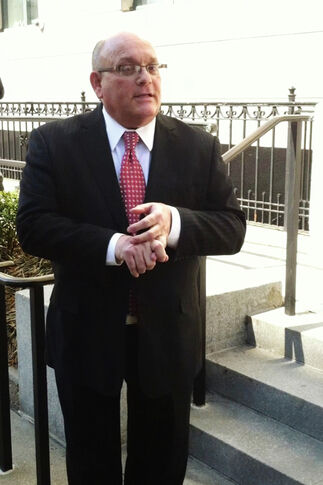
A dozen reporters and photographers gathered on the sidewalk outside the courthouse, waiting for Bencivengo to take care of post-sentencing business. The building blocked the sun, and a cold wind whipped down East State Street.
After several minutes, Ballarotto emerged from the building without his client, and started addressing the media. He expressed disappointment in the government and said the FBI allowed Ljuba to toy with an emotionally vulnerable Bencivengo, before narrowing the focus of his complaints to Bartle.
“If you pay close attention to the comments that I made today, there’s a very fine line in what happened in this case, in how [Bencivengo] got convicted,” Ballarotto said. “He did not get convicted for violating his oath as the mayor of Hamilton Township. When Judge Thompson asked that question directly to the United States Attorney … she had to construct her answer because he couldn’t.”
Ballarotto stopped for a second to collect his thoughts. He opened his mouth to continue defending his client but—before the words came out—his audience had turned its attention elsewhere. Bencivengo had strolled out of the courthouse at that moment, and one of the reporters yelled after him.
Ballarotto turned and watched as the media swarmed Bencivengo. The attorney didn’t move from where he stood.
Bencivengo smiled weakly at the sudden attention. “I’m glad it’s over,” he said, before attempting to continue down the steps of the courthouse. He couldn’t go far; reporters had blocked his path.
“How will you spend the next 45 days?” a reporter shouted.
“I’m going to spend it with my grandchildren and my family, and get this behind me,” Bencivengo said, emphasizing several words by slamming his right index finger against his left hand.
He turned toward a grey Jeep—his ride—and offered perhaps his final public words for more than three years.
“Thank you.”
Then he worked his way through the throng, got into the Jeep, and it drove away.
,

