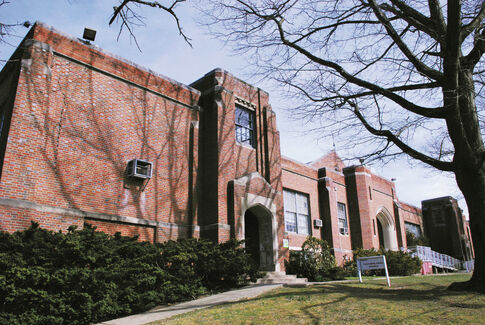
The Valley Road School building has become a source of contention between the Princeton School District and a group of residents who wish to acquire the building and adapt it for use as a community center with nonprofit organizations as tenants. School district officials have rejected the proposal as unfeasible.
In July, the proponents submitted a petition with the signatures of more than 2,100 voters to the borough council asking for a nonbinding referendum on the issue in a special election at the end of August. The council rejected the request, stating that the township has no control over the building since it is owned by the school district.
The building — now almost 100 years old — opened in 1918 and was Princeton’s first integrated elementary school. In May, the building was named by Preservation New Jersey to its 2013 list of the 10 most endangered historic places.
Below are the opinions of both sides of the debate. School Board President Timothy Quinn and Vice President Andrea Spalla express the school district’s opinion. Representing the point of view of the proponents is Richard Woodbridge, chair of the Valley Road School-Adaptive Reuse Committee and Kip Cherry, president of the Valley Road School Community Center Inc.
The School Board View
By Timothy Quinn and Andrea Spalla
In light of certain recent articles and letters regarding the property at 369 Witherspoon St. in Princeton (also referred to as the old Valley Road School), we would like to clarify the Princeton Board of Education’s position, as legal owner of that building.
Since at least 2006, the board has sought proposals for the future use of 369 Witherspoon that meet the board’s objectives for the property and would well serve the community.
One such proposal was submitted by the local nonprofit Valley Road School Adaptive Reuse Committee (VRS-ARC), which sought to take control of and renovate the building for use as office space for nonprofit organizations.
In early 2011, the board indicated its initial support for the concept proposed by VRS-ARC, in the hope that VRS-ARC would then develop a detailed, feasible and financially viable proposal. At that time, several board members were interested in the group’s vision for the building.
But the devil is in the details. In March of this year, after several years of meetings and correspondence between the board and VRS-ARC members, the board unconditionally rejected the group’s final proposal. In sum:
1) The VRS-ARC group failed to credibly demonstrate that it could secure funding for its proposal despite having many years to do so. Rather, the group blamed its inability to raise money or even secure pledges for future donations on the fact that it did not yet have the building, and it insisted that once the board gave it the building, the group believed it would then be able to raise funds. In other words, the group demanded that the board cede control of a valuable real estate asset on faith and verbal assurances alone. Given the absence of any evidence of the group’s ability to fund its proposal, the board would have been in breach of its fiduciary responsibility to the community had it given the property to the group.
2) While the structural engineer hired by the board estimated that the likely construction cost for even a basic renovation of the building would be at least $10.8 million, the group refused to accept that estimate and insisted that its own, much lower, estimates should instead prevail. The VRS-ARC’s own cost estimates are, in the board’s view, extremely unrealistic and not supported by any structural engineering reports.
3) The group failed to submit a proposed legal agreement that would meet the board’s stated legal/ownership objectives.
4) The group’s proposal failed to provide even minimally acceptable plans for the required zoning changes.
5) The group refused to accept the board’s demand for sufficient insurance to indemnify the board for liability arising from the group’s proposed use of the property, making it an unacceptable financial risk to the board and, by extension, to taxpayers.
The board’s unequivocal rejection of VRS-ARC’s proposal was made and explained publicly, reported in local news stories and posted on the school district’s website. Now VRS-ARC seeks to circumvent the board’s well-supported, reasonable decision by petitioning for a ballot referendum requesting that the Princeton Council, which has no authority over the property or the board of education, force or pressure the board to simply hand over a school district asset to this group of private citizens — a group that has already had years to develop an acceptable proposal, has failed to do so and now refuses to accept the board’s final decision.
The attorney for Princeton council informed the VRS-ARC members at the last council meeting that what it seeks is outside the scope of applicable law and beyond the municipal government’s authority. The board of education fully agrees. The municipality can no more dictate to the board of education what to do with its buildings than the board can dictate to the council what to do with Witherspoon Hall or any other property to which the municipality holds title.
Finding a sound, smart use for 369 Witherspoon has been and continues to be a high priority. As stated many times, the board seeks a solution that:
1) Does not put the board in position of landlord, but does allow it to retain a legal interest in the land should its facilities needs change at some point in the future (some point far sooner than 100 years).
2) Has no or minimal financial impact on the board.
3) Serves the best interests of the school district and community, and is demonstrably viable from architectural, engineering, legal, logistical and, most important, funding perspectives.
4) Includes or provides for uses for education, recreation and/or counseling.
We hope this information provides a more accurate summary of recent events regarding 369 Witherspoon St.
The Proponent’s View
By Richard Woodbridge and Kip Cherry
We want to set the record straight on Valley Road School. First, we would like to point out that the school board holds its assets on behalf of the taxpayers — us. The names of the school board members are NOT on the deed and when they leave office they don’t sell or return their shares, they simply walk away. They are really asset managers, and as asset managers they have been doing a really poor job of stewarding the assets of historic Valley Road School held in their care on behalf of the taxpayers.
There are numerous nonprofit organizations around the country that have successfully taken over old, unused schools and converted them into centers for nonprofits. It is doubtful that any of them could meet all the “criteria” of the school board. It makes you wonder whether these criteria are intended to protect the taxpayers or just fend off any nonprofit group that might try to show that VRS can be adaptively reused. The school board expects donors to make commitments of large sums of money without any commitment whatsoever from the board that it intends to sell, lease or give the building to the nonprofit.
Additionally, the school board claims that the “likely construction cost for even a basic renovation of the building is at least $10.8 million.” VRS-ARC/VRSCCI (Valley Road School Adaptive Reuse Committee/Valley Road School Community Center Inc.) made an Open Public Records Act request for the back-up justifying this number and was told that the school board had received no additional documentation from the structural engineer who made this claim. “You have what the district has.” While VRS-ARC/VRSCCI’s cost estimator, Spiegel Consultants, has released a construction cost estimate, with detailed backup, of $3 million, with a total cost of $3.9 million, including contingencies.
The school board also claims that VRS-ARC/VRSCCI failed to provide “even minimally acceptable plans for the required zoning changes.” Not true: VRS-ARC/VRSCCI submitted a proposed zoning amendment to the school board in August 2011, which covered land use and parking, and got no constructive response. Finally, we submitted the amendment to the mayor for consideration and the school board strenuously objected.
Now, regarding the assets for which the school board is in their words “the legal owner.” The property was sold to the “inhabitants of Princeton Township” in 1918 for $2,000. The inhabitants bought the property and were listed on the deed as the legal owners. In 2002, when the school board wanted to renovate the newer portion of the building, they ran into a problem. They were advised that they didn’t own the building, didn’t even have a long-term lease. So naturally they couldn’t proceed with their project. Doesn’t that sound familiar? So they went to Princeton Township because they were advised that the municipality theoretically represented all of those inhabitants who bought the building in 1918, and therefore the town was the legal owner of the building. The township agreed to sell the building to the school district for $1.
We would also like to note that we submitted our detailed proposal to the school board for the Valley Road School Community Center in good faith in June, 2011. We believe that our proposal is bona fide, and in fact is the only bona fide proposal that the school board has received. Since that time, we don’t feel that the school board has ever genuinely tried to work with us, or been willing to negotiate with us to develop an agreement or letter of intent.
The school board worries that allowing a nonprofit group to save the building would be breaching its fiduciary responsibilities to the community. Let’s see the school board show how much it feels its fiduciary responsibilities by putting some muscle into the idea of patching the roof and maintaining an interior environment to make sure that the building is not further damaged by rain and melting snow.
Our fear is that the school board won’t take steps to winterize the building by draining the pipes or keeping a minimal amount of heat in the building to keep the pipes from freezing.
Well over 2,000 local voters signed a petition asking for the municipal government to put a question on the ballot regarding saving Valley Road School. And if we had continued to circulate the petition we could have gotten more. When an issue was raised by a member of the Princeton Council regarding the authority of the council to place such a question on the ballot, we further clarified the question by limiting it to the actions of the municipality in future negotiations with the school board. Whether or not a question is put onto the ballot, the public has spoken. We feel that we owe the people who signed the petition our best efforts to continue to allow them to be heard.
,

