A sushi chef with culinary flair and immense geniality, Sushi John, a resident of Princeton, welcomes all comers to his 12-seat sushi bar in the Ya Ya Noodles restaurant at the Montgomery Shopping Center in Skillman.
Born Ming Xi (in English, John) Zhang in Qingdao, a city of over eight million in eastern China near the ocean, Zhang encountered lots of fresh, high-quality seafood as a child. “It was number one in the world for the quality of its seafood,” he says, noting both its freshness and variety.
Living in Qingdao Zhang grew up eating the Chinese-style fish his father loved to cook. “My dad liked the fish steamed, then put some sauce, ginger, wasabi and hot oil on the top; it was very delicious,” he says.
Through these early experiences, Zhang developed a feel for fish that allows him not only to assess quality but also to understand the innate taste of each fish and what kinds of sauces can enhance its flavor. “I buy fish very fresh, and I have a feeling — I know what kinds of ingredients mix together and match,” he says.
As conversation flows easily between Zhang, this reporter and a editor/photographer from the Princeton Echo, he asks a couple of question to ascertain our likes and dislikes and deftly creates one sashimi or sushi dish after another, each uniquely flavored and beautifully presented.
Knowing who his customers are and what they like is one of Zhang’s specialties. “I know everybody’s name; the second time I see them, I can call them by name,” he says. “People don’t need to order. I know everybody. They don’t need to speak, and I can create a dinner for them.”
A couple of customers are eager to explain why they are regulars at Sushi John’s. Ted Altman, who lives in East Windsor but works in Skillman, says, “I come here twice a week, because it is a great value and it is delicious, and John and [sous chef] Nick (Song) put a special flavor into it that can’t be beat.”
Charles Leighton, who lives in Kendall Park but also works in Skillman, says, “The food is always extremely fresh, and these two gentlemen are about the most decent, kind people you would ever want to have serving your food. It is educational; and they are very accommodating. It’s my neighborhood diner, except upscale.” Then he adds, “You also learn a little Chinese when you come here.”
Zhang didn’t start off life as a master sushi chef. At Ocean University of China In Qingdao, he studied electrical engineering, and he worked in human resources for the government for about eight years.
Then he opened his own restaurant, Shi Tai Yan, where he served mostly Chinese food, but also did a small business in old-style sushi, with very simple ingredients: cut fish, ginger, and wasabi (Japanese horseradish).
In 2000, when the Chinese economy was struggling, friends told him about America, and he decided to have a look. When he traveled here in 2000, he ended up staying.
In America he found a new style of making sushi and sashimi, which used different sauces to enhance the taste of the fish. He taught himself a lot about this approach to sushi by reading books and watching chef shows on television. Then he learned on the job.
Today Zhang also tries restaurants all over New Jersey on his days off to pick up new ideas.
For three years Zhang worked dinner at Brix67, an Italian restaurant with a sushi bar in Summit. From this experience he learned something about Italian ingredients that actually expanded his sushi repertoire to include chive oil as well as herbs like rosemary and thyme for his sauces.
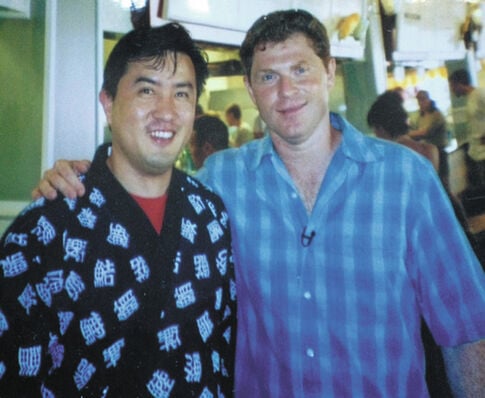
During summers he worked in Point Pleasant at lunchtime and had the privilege one day of serving renowned chef Bobby Flay, who stopped by with friends and told him, “Oh, John, I love your sushi.” A picture of Flay and Zhang sits on the counter of Sushi John’s.
Then in 2004 Zhang became head sushi chef at Mahzu, in Aberdeen, where he had seven chefs working for him. “I was very famous over there,” he says, noting that people from towns all around came to eat sushi and hibachi. The sushi bar there served 50 to 60 people a night, and reservations were required.
The picture he draws of the Mahzu sushi bar brings to mind the name of his first restaurant in China, whose Chinese characters translate as “eat, big, party/food,” a name that could be rendered in English as “A big food party.” These words summarize how Zhang understands the nature of a sushi bar. “People get to know each other — first they’re talking to me; later we’re talking together. We’re like a family,” he says.
A resident of Princeton for about seven years, Zhang started Sushi John’s in April 2011, in a restaurant owned by friends. In fact, the owners of Mahzu and of Ya Ya Noodles have been Zhang’s mah-jongg partners and friends for years.
Not surprisingly for a man whose father teaches gym in middle and high school and mother teaches elementary school, Zhang does a little teaching as he produces exquisite sashimi and sushi masterpieces, one after the other.
He explains, for example, how he makes sure the fish he uses is high quality. “I’ve touched fish starting as a kid,” he says. “I can look, touch, and smell, and I know the fish is good quality and fresh,” he says, noting that very fresh fish is moist, not dry.
Or who knew that there are three different kinds of tuna — blue fin, big eye, and yellow fin — and blue fin, which is a darker red, is the top quality? And, like steak, within each fish, different parts of the tuna vary in color and quality, with the fatty part, called the toro, or tuna belly, the best.
When his fish are either delivered in the morning or he picks them up at the fish market in Elizabeth, Zhang checks all the fish and then separates them based on quality. The highest quality fish are for sushi and sashimi, lower for rolls.
Since the flavor of fish is so delicate, Zhang does not use soy sauce in the sauces he creates, except for a little in his ponzo sauce. “If you use soy sauce, the fish all taste the same,” he says. “My sauce is light, so when you eat a salmon with my sauce, you can still taste the salmon and the flavor may be better.”
Talking about the rainbow of sauces that he uses, like wasabi cream or sweet chili, he says. “Some sauces are for taste, some are for looking nice.
Over a two-hour feast, Zhang served up a variety of sashimi and sushi, while chatting and joking around: Thin slices of yellow tail with six different kinds of sauce. Torch-seared tuna with chili pepper and sauces, on cucumber, with caviar on top. Fluke and spicy salmon with leaves of lettuce in the center, surrounded by dots of red, blobs of yellow, a spritz of strawberry sauce, a spray of green chive oil, and a sprinkle of sesame seeds. Hot lava roll, with avocado, spicy tuna, and yellow tail, wrapped in soybean paper with a special sauce. Steamed lobster, topped with a slice of tuna and tempura flakes. Salmon sashimi on daikon radish (which can clear the palate, as ginger can do as well).
To top off the meal, he produces a sushi dessert of an apple, topped with spiced fish and a plum. “People say these are better than chocolate,” he says.
Zhang has a number of commercial customers, including Main Street, the Nassau Inn, and Cherry Valley Country Club, who either pick up sushi and sashimi or invite him to come provide sushi over cocktails.
When customers come in the first time, Zhang urges them, rather than ordering, to tell him what fish they like, how hungry they are, and what level of spicing they are comfortable with, and he can create a full meal for them with soup, salad, entrée, and dessert, starting at $28. Then the next time, they can order for themselves.
Running a sushi bar is hard work, but satisfying for Zhang. ““I like to eat, and I like to cook,” he says. “When I’m working, I’m always full of energy “When I’m doing the sushi bar, I’m very happy.”
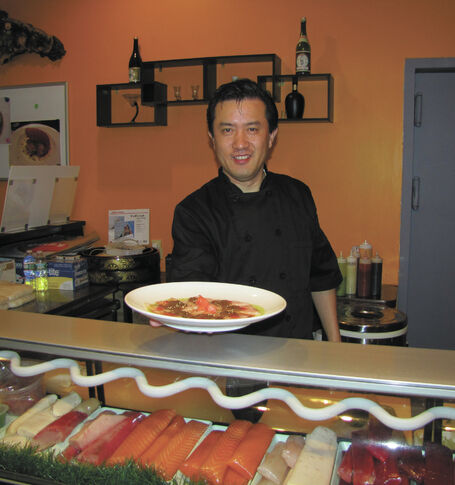
Chef “Sushi John” Zhang serves up an order of tuna sashimi smothered in his special sauces at his sushi bar in Ya Ya Noodles restaurant in the Montgomery Shopping Center. (Staff photo by Bill Sanservino.),