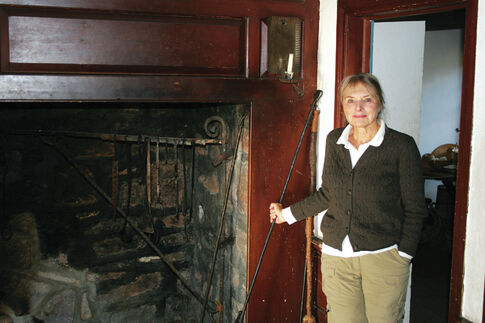
Nancy Carter Ceperley in front of the hearth at the Johnson Ferry House, built circa 1740, where she works as a historian. (Staff photo by Joe Emanski.)
Historian has half a century of Christmas Day memories at Washington Crossing State Park
Nancy Carter Ceperley may not have followed in her parents’ footsteps, but she has arrived at the same destination: Washington Crossing State Park.
There she can often be found on Christmas Day, a historian in period dress, on hand to help tourists understand what they are seeing as they watch a reenactment of George Washington’s 1776 crossing of the Delaware River. Washington led the Continental Army from Pennsylvania to New Jersey on Christmas night, en route to their assault on the Hessian garrison in Trenton in one of the American Revolution’s pivotal battles.
Ceperley’s family moved from a 1711 stone farmhouse in Newtown, Pa. to Titusville some 50 years ago. Her parents, Mitchell and Annette Carter, hadn’t lived in town long before they helped form the Washington Crossing Association, a friends group that no longer exists, but which held events and raised money in support of the park for decades.
For many years, they remained heavily involved in the organization. Ceperley says each of them probably served in every board role at one time or another. She thinks the friendship they developed with then-superintendent Dirk van Dommelen probably led to them to become so involved.
“I think [their interest] was probably really prompted by living here in the middle of it, and having it all around you all the time, and their friendship with the park superintendent, who really was very passionate about the park and about the history,” Ceperley said.
In his professional life, her father was president of the family manufacturing company, Cartex, which he formed with his brothers. Cartex made custom-molded foam rubber cushions and other products using a process her grandfather, Mitchell Sr., had invented.
Ceperley said when she was younger, she was never that interested in what was going on at the park. She was a good student of social studies, but when she graduated from Temple University, her degree was in art.
In the meantime her parents had become ardent participants in the reenactments. Her mother would portray a camp follower in the Egg Harbor Guard, and for the Bicentennial crossing, her father played ferryman James Slack, even going so far as to build by hand a replica of the ferry Slack used to help the troops get across the river. The ferry was actually used in the reenactments in 1976 and ’77.
She remembers her father enlisting her one Christmas to crack eggs for the hot cider drink he was preparing. It was her “first literal taste” of getting involved. But it wasn’t until she took a part-time seasonal position at the park in her early 30s that she really began to walk down the path of the park’s history.
* * *
Washington Crossing State Park covers more than 3,500 acres in northern Hopewell Township. For many today, it’s as much a home to soccer fields and nature trails as it is the place where the tide began turning in the Revolutionary War.
Many of the park’s historically significant sites are concentrated in its southern tip, and it’s there you will most often find Ceperley, stationed at the Johnson Ferry House as a historic resource interpretive specialist — or historian, if you prefer brevity.
The ferry house was built around 1740 by a Dutchman named Rutger Jansen. His son Garret established a farm and ferry service on the site, but by 1770 the Jansens had to sell. At some point in between, the name Jansen became Johnson.
Though Abraham Harvey had purchased the plantation from the Johnsons, it was another Dutchman, Slack, who was renting it and operating the farmhouse as a tavern in 1776. Today, Ceperley works there year round, speaking to tour groups, schoolchildren and wandering joggers alike about the house, which is filled with period artifacts The ferry house has a kitchen garden and a huge hearth, both of which are sometimes put to use for cooking demonstrations.
Around this time of year, she and four or five volunteers from the area begin making preparations for Christmas Day, when they will receive a couple thousand people at the Nelson House, another historic park building situated closer to the water.
The reenactment is orchestrated on the other side of the river, at Pennsylvania’s Washington Crossing Historic Park. There, George Washington (that is, a reenactor dressed as Washington) gives a speech and mounts his horse, and soldiers march.
But the Jersey side still has a role to play. The eastern bank of the Delaware affords vantage points from which the boats can be seen departing from the opposite shore and making their way across.
Most years, Ceperley is among those set up at the Nelson House to serve as hosts and guides. They serve hot cider to chilled visitors and “interpret” the crossing, which is to say, they explain to those present what they are seeing out on the river and its banks.
“Very often, I do a running commentary,” Ceperley said. “I’m pretty much talking to the clusters of people who come in, get their cider, listen for 15–20 minutes, warm up and move on.”
Most years there is also a military historian on hand at the visitors center giving a lecture with a more tactical bent. And sometimes there are special programs, like one held a few years ago about the use of horses in the 18th century.
Some years, because of inclement weather or strong currents in the river, the crossing has to be canceled. Those are the toughest years for Ceperley and the volunteers, she said, because visitors tend to be disappointed when they don’t get to see the reenactment.
She still lives in Titusville, though not in the house she grew up in. Last year, she woke up Christmas morning with flulike symptoms, and missed the crossing. And there have been other years when she has been out of the area and unavailable to participate.
But most years she is able to take part, and she said she is looking forward to this year’s crossing. “It’s just what Christmas is for me,” she said.
* * *
Ceperley has worked at the park in one sense or another since 1982, when she took a position as a seasonal employee. She said her mother “talked her into” taking a summer position at the Nelson House. She says she kept applying for jobs in the art world, but was told by prospective employers that it sounded like she liked the job she already had and she should stick with it.
In November 1986, the park superintendent wanted someone to act as caretaker for the Johnson Ferry House, and hired Ceperley for the role part time. In spring 1987, a full-time position finally opened up, and Ceperley was hired.
A great deal of what she knows, she says, she learned on her own. She wanted to be able to answer any questions that visitors might have about the site. But she has also earned the course credits required of her to rise to the title she now has, historic resource interpretive specialist.
She also has a master’s degree from Philadelphia Biblical College, now Cairn University, where she studied the Bible and where she met her husband, Gordon. Gordon Ceperley has since passed away.
Ceperley says her spiritual studies inform her historian’s perspective on the Colonial and Revolutionary periods.
“The faith of the Founding Fathers, and the faith of the soldiers, is what I see as what got them through the hardship and what gave them the courage and vision to be able to fight and do what was humanly almost impossible,” she said.
The Johnson Ferry House is open Wednesday through Saturday from 10 a.m. to noon and 1 to 4 p.m., as well as Sunday from 1 to 4 p.m.
Two lantern walking tours are scheduled for Friday, Dec. 20, one at 7 and one at 7:30 p.m. On the tours, visitors will have a chance to learn about the Nelson House, the Johnson Ferry House and the Stone Barn. Tours depart from the Nelson house; groups are limited to 25, so registration is recommended. To register, call (609) 737-2515. The fee is $10 for adults and $5 for children and seniors.
,

