
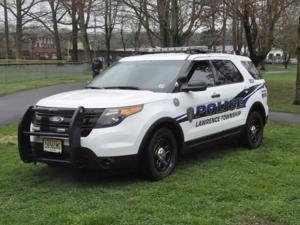

Lawrence Municipal Manager Kevin Nerwinski recently sat down with the Lawrence Gazette to talk about issues impacting the township.
The first part of the Q&A resulting from that interview ran in the April issue of the Gazette and addressed the future of fire and emergency services in the township. To read that article, go to communitynews.org.
This month, Nerwinski talks about the police department and difficulties facing law enforcement in 2023.
One of the biggest problems facing towns is the dwindling number of people seeking jobs in law enforcement.
“Law enforcement agencies across the United States are struggling to recruit and hire police officers. Though agency-specific needs exist depending on size or locale, the difficulty with recruitment is a significant problem that is broadly affecting the field of law enforcement—it is not simply a result of poor agency management or localized failures,” said to a report released in 2019 by the International Association of Chiefs of Police titled “A crisis for law enforcement.”
That number has only gotten worse. In 2021, the N.J. State Police reported that applications dropped from 15,000 to 20,000 to just 2,130 over a one-year period.
Officials in several Mercer County communities interviewed by the Gazette have confirmed that the trend is continuing.
Also discussed with Nerwinski was the state of this year’s municipal budget and money raised by taxing the sale of adult-use cannabis. An edited version of Nerwinski’s conversation with the Gazette appears below.
Lawrence Gazette: I have spoken to officials in several towns who have said that the numbers of people applying for police officer jobs is way down. Do you find that to be the case?
Kevin Nerwinski: That’s correct and I think that’s nationwide—not only here. I mean, you spend a little bit of time on social media and you understand the difficulties that police sometimes cause themselves. But other times, you know, it has become a dangerous job, not just physically dangerous, but also, you can find yourself in a situation you never expected.
I think people are looking elsewhere. We are a civil service community, so we hire police more often than not from the civil service list. Going through a list to find applicants that satisfy our requirements is becoming more difficult. People just aren’t of the quality that we need at this point in time, because the job is is challenging on all levels—physically, emotionally.
We’re looking for the personality traits that look to de-escalate versus responding more forcefully. So that so that’s becoming a challenge. Chief (Christopher) Longo has done an incredible job. I’m really happy with his leadership and his style of leadership.
We included a captain—Captain Joseph Lech, into the department hierarchy there, and the captain is supposed to take on primarily the day to day operations of the police department, where the police chief kind of sets the policy and tone. And I think it’s working really well.
We’re hiring now. We’re coming upon a group of officers that are ready to retire, and we never really know when they’re going to hit the button to retire because they’re always looking for their next situation, and when they find that, that’s when they hit the button. So there’s no way to plan.
A new officer from the from beginning to getting that officer hired to on the street to work as a police officer is a little less than a year. So it’s an investment of time to get them.
So when an officer signals they’re retiring, we’re immediately looking for applicants and then waiting for the scheduling of the next academy, because it’s its only like two or three times a year.
Then, because the older police officers are retiring, you have a deficiency of officers in the middle of the pack—the 15 year veteran. We’re missing that element, so we’re trying to use the ability to hire transfers from other departments.
I think that helps us fill that gap so we can have a more consistently built police department where the ages are incrementally higher. With time on the job comes experience.
Think about it. You give a young person a badge and a gun and you train them, but in the end, they’re out there on their on their own and they’re going to rely upon their own skills, background, integrity and morals. There’s an element of hope that they do the right thing every single time. I would not be honest if I said that I don’t worry about that at times.
LG: Lawrence is an interesting community because it kind of runs the gamut from very high-end housing to basically urban rim areas. And you also have Route 1, which comes with its own set of difficulties.
KN: I think from a law enforcement perspective, it’s definitely a very eclectic community to navigate through as a law enforcement officer, for sure. They come across a lot of different challenges throughout the course of their day.
LG: Yeah, and I don’t think many people stop and think about how difficult a job policing is.
KN: And now add on to it. I think more so than ever, people are feeling empowered to push back without civility and without basic respect prompted by nothing. That’s a challenge for any police officer at any level of experience to make a traffic stop and immediately be exposed to a disrespectful individual before they even engage them.
LG: I see a lot of videos on social media where from the get go, a person is totally uncooperative with the officer and the officer is being professional. And the situation just escalates from there, because the person won’t comply with what the officer is asking for. They say, “I don’t have to show you my ID. The Supreme Court says I don’t have to. And then there’s the sovereign citizens.
KN: I talked to Chief Longo about that when he first started as chief. He and I both agree, we’re on the same page that the way you combat that is through training and knowledge.
I’m sure you’ve seen on social media, where nine times out of 10, police officers get themselves in trouble because they just don’t know the law themselves. And if you don’t know the law, then all of a sudden you start to push back in a negative way that escalates the situation.
I know our police officers are engaging in more and more training in that regard, and that’s the best we can do. And those tools that we give them to help them each day is our obligation to them.
The municipal budget and cannabis revenue
LG: Okay. Let’s move on to let’s talk about the general economy now and how it has affected the township budget. I know you’ve addressed the budget in your column (in the Gazette) and on your blog, and you explained a lot about what’s going on with the budget. What are some of the challenges that inflation and the pandemic have created?
KN: I’m trying to make the budget process as transparent as I can in my communications with the community, so they better understand where we’re coming from, because it is their money that funds the municipal services that they receive.
So, as I said in my budget message for this year, the inflation that our residents feel is also felt by the municipal government the same way. The cost of gasoline that we put in our equipment and vehicles and equipment is at a higher cost. We feel the same thing in insurance increases.
Waste disposal is a significant thing. We contract with a vendor. We go out to bid. We hope to get multiple vendors bidding. But we only have one that bids, and they set the price of the contract. Going in house (for trash collection) is just not something that’s doable at this time.
The contract went up 20%. A significant amount, because they’re experiencing the shortage of manpower and quality workers that they need to rely upon. And so that gets passed on to the end user, which is the town, which is the residents.
So that’s why in my budget message I really tried to stress that there are things beyond our control and in this year’s budget we can’t control several big factors. One is that all the employees here are under a bargaining unit agreement, a labor agreement. The negotiated cost of living increase for 2023 among each one—because I work hard to try and keep things equal among all the bargaining units—is 2.25%.
About 40% of our municipal budget is the salary and wages of the people that we pay. And then as of Jan. 1 of 2023, it was 2.25% higher. That’s a significant increase that we have to deal with in some way.
In this year’s budget we have identified firemen, EMTs and two public works employees that are absolutely necessary to do (hire). And when you look at those two combined things, there’s only several hundred thousand dollars more that you can look at and say, “okay, this is the increase of $1.2 million from last year, the amount that we’re raising for taxation.”
I think that our municipal government and our departments are staffed really lean. We don’t have excess people anywhere. So the thought of downsizing at this time is not realistic, because we won’t be able to produce the services that we need to produce.
LG: The tax increase 2.5 cents (Following the interview, the Township Council reduced the tax increase to 2 cents per $100 of assessed valuation). Any tax increase is too much in the minds of a lot of people, but 2.5 cents isn’t horrible, all things considered. I’ve seen much, much worse.
KN: I think is for this year. Lawrence always comes out of the gate sooner than most other municipalities in our county as far as work on our budget. I’m really interested to see how other towns are affected. I think that budget from year to year also relies upon what you’ve done in years past.
In the five years getting to this point, we have reduced our debt. We have increased our surplus, we have made ourselves a top-rated municipal government by Moody’s (bond rating company), which allows us to get the best financing possible. We have all those things happening and then add the fact that we focused on grants over the last couple of years.
We had a part-time municipal engineer, Brenda Kraemer, and I thought it was a perfect choice for us to give her a full-time position and make her centrally responsible for all our grants. We have $5 million in grants in this last budget that we have. It’s crazy. That allows us, as a community, to keep moving forward with capital improvements. Whether it’s a dog park or the Brunswick Avenue streetscape or whatever. We don’t have to sit here and enlarge our debt to do things. And I think it’s allowed us to continue to grow the way we need to grow.
LG: This is the first year where I would assume you’ve seen some revenue from cannabis sales. Generally, how much did that revenue help the township?
KN: It’s incredible. It’s a game-changer. Say the town gets a new development or a new warehouse. They don’t normally move the needle that much because there’s always a cost behind it. But the cannabis tax for this municipality is about $900,000 that goes to the municipal government.
LG: Right. And that was just one facility.
KN: Yeah one. I’m really proud of how we handled this. First of all, 70% of New Jerseyans felt that the legalization of cannabis was appropriate. In our town, the numbers are a little bit higher than that, in terms of how they voted in that referendum. So, we knew that the people thought it was a good idea, or an acceptable idea.
Our challenge was, do we want it in our town? And if we do, how should we regulate it? Because the state law really gave the towns a lot of power, we determined that, number one, we do want it. And number two, that we need to ensure that it’s highly regulated. We were able to identify the corridor along Route One away from all residential communities and neighborhoods, making it a destination place and limiting it to two retail cannabis sellers.
It’s worked out really well, and now, the second one—at the former Crab Shack on Route 1, is really close to being final.
LG: It’s basically across the street from the other retail location—Zen Leaf. Both sides of the highway are basically being served.
KN: I don’t know if you have ever driven by Zen Leaf. There are always cars there, and I don’t think it’s going too far to say that there was probably a little bit of a public safety issue there. The second site is going to help eliminate that. It’s not going to be just one location, so it’s going to be less people there. Spread out. I think it is a safer situation for all.
In 2023 we were able to include in our budget a half a year of that tax, $450,000. You can only budget for what you have realized in the year prior. We only received $450,000. So next year, in the 2024 budget, we’re going to be able to realize $900,000. So, if it’s 2023 and it had a full year, our tax increase would have been a penny less.
We know that money’s going to be there, but we have to comply with budget law. So literally, $460,000 is a cent. We would really be at 1.5 cents, but we’ll get that next year. Which allows us to hire police officers, firefighters, EMTs, it’s a big deal.
LG: Do you anticipate it will stay at that level going into the future?
KN: It’s going to get less every single year, but being out front is important, because there’s only, I think, 12 permits statewide. That’s going to double or triple by the end of this year, I think. So now people aren’t going to be coming into Lawrence from 25 miles away. I think the closest one right now is Bordentown. I don’t expect the $900,000 to continue, but with businesses on both sides of Route One, we’ll probably still get our fair share.
LG: What about manufacturing and grow facilities? Do you have any?
KN: We have none online right now.
LG: Are there any on the horizon?
KN: I’ll tell you what. One of the concerns I think any municipal government has is a consequence of the pandemic. I don’t know if it’s a negative consequence, but I think companies realized they don’t need to bring their workers into work every day. That home employment has its positives, if done the right way. And so some of our corporate centers are becoming less occupied and some not occupied at all.
They have to be reimagined in some way. And I think the cannabis industry is going to fill that void. We have a couple of large buildings in our industrial zones that I think are perfect for that type of industry. So, we’ll see.