
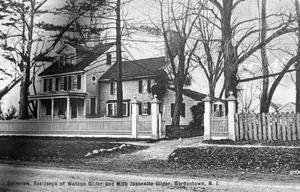

Part 1 of 2
During the mid-1800s, a group of several notable individuals, known as “fireside poets,” resided in New England. Raised in traditional Puritan spirit, these intellectuals wrote imaginative prose in subtle tones that were framed within the morality of human nature.
Their intriguing themes about American life and the beauty of the environment captivated those that read their books with family members huddled around the fireplace. For a brief moment, readers were transported from any social problems or disappointments that punctuated their lives.
Poets such as William Cullen Bryant (1794-1878), Ralph Waldo Emerson (1803-1882), Henry Wadsworth Longfellow (1807-1882), and John Greenleaf Whittier (1807-1892) expressed in pen and paper the same sensitivity as walking in the woods. Their influence as diplomats, academic scholars, and journalists, shaped the country’s political spectrum at the time. Furthermore, their printed sentiments about life in general embraced the common man.
Richard Watson Gilder (1844-1909) considered himself a disciple of the fireside poets. Born in Bordentown to Rev. William Henry Gilder (1812-1864), a Methodist minister, and his wife, Jane Nutt (1816-1885), he was the fifth child of eleven siblings, eight of whom survived to adulthood. His home, called “Belle Vue,” was originally built in 1725 to compliment the small farm. In 1788, Samuel Rogers (1725-1813) built the prominent two-story section.
Rogers’ second wife was Mary Kirkbride (1728-1800), the sister of Colonel Joseph Kirkbride (1731-1803) who built a home in town that he named “New Bellevue.” Ironically, he was married to Mary Rogers (1730-1808), the sister of Samuel Rogers. Another sister, Elizabeth Rogers (1725-1807) was married to Col. Joseph Borden (1719-1791), the son of the town’s namesake. Rogers deeded his house and property to Thomas Nutt (1768-1819) and his wife, Lydia Bunting (1769-1847) upon his death. They had 10 children.
Their daughter Jane became acquainted with Rev. Gilder when he was stationed at Crosswicks in 1833. Two years later, they married. It was during this period that the couple traveled to other states, since Reverend Gilder was an ordained minister.
Eventually, they settled in Philadelphia where he was born and raised. His father, John Gilder (1786-1855), a member of the Whig party, served in the Pennsylvania Legislature, was an active member in the Carpenters’ Company in Philadelphia, and laid the cornerstone for Girard College.
While in Philadelphia, Rev. Gilder published a quarterly literary review at the time that he was starting a family. Although the review was discontinued for financial reasons, his new role as a father challenged him to try something else. In 1842, the Gilders returned to Bordentown. Always the preacher, the good reverend decided to establish the Belle Vue Female Seminary For Young Ladies, on the sacred ground that he knew so well.
Every room was immaculate and fresh. Tuition and room and board for the year cost $118. As enrollment for the school grew, so did his family. In the upstairs bedroom besides the glowing embers of a crackling fireplace, Richard Watson Gilder was born in 1844. Four years later, the family moved to Flushing, Queens in New York where Reverend Gilder opened the Flushing Female Seminary as headmaster. At a young age, Richard was the only boy educated in a school of girls. In addition to learning about reading, writing, arithmetic, and English, he also studied French and Greek languages.
When he wasn’t in class, he would walk to the office of the Long Island Times and watch the movements of the mechanical press through the window. Soon his curiosity led him to ask the editor on how to set type. It wasn’t long after that he accomplished writing issues for two of his children’s publications, the St. Thomas Register and The Leaflet.
Although he was physically frail and suffered from health issues, his mind was constantly focused and sharp. His religious zeal was equally productive as he attended Methodist, Episcopal, and Baptist services. Ministers with forceful orations resonated through the aisles and filled the boy’s soul like the remedy for a patient. These experiences affected him deeply and made him a better person throughout his life.
Unfortunately, the school was eventually abandoned. The Gilders moved to Connecticut and then back to New York to open a day school, but the menacing specter of the Civil War was a challenging obstacle to overcome. By 1860, the family came back to the familiar streets of Bordentown and stayed with Jane’s unmarried sister, Maria Nutt (1813-1889), who was the current owner of Belle Vue. While residing in town, patriotic fervor ran rampant amongst its citizens. Young Richard joined a cadet militia, his second oldest brother joined Duryea’s Zouaves, and his father enlisted as a chaplain of the 40th New York Volunteer Infantry.
No one was immune from the horrors of war. In 1863, Richard began to study law when he enlisted with the 1st Philadelphia Battery under Captain James Parker Landis. Serving as a private, he saw active duty during the Gettysburg Campaign. His older brother, William, serving as captain of the 40th New York Volunteer Infantry, was wounded at the Battle of Gettysburg.
A year later, Rev. Gilder contracted smallpox while caring for plague-stricken soldiers, and died at Brandy Station, Virginia. With the reality of his father gone, Richard had no option but to withdraw from his law studies. To make ends meet, he applied for a job as a paymaster on the Camden and Amboy Railroad. Considering his age, physical appearance, and being unarmed while carrying cash, the elements of danger were too great to continue after a year. It was then that he found his true calling.
In the meantime, Richard’s aunt Maria continued to operate the Belle Vue Female Seminary in Bordentown after the war ended. Boarding and day school students were charged $52 per quarter year or $208 a year for services that included laundry, clothes repair, art lessons, piano lessons and the study of French, German, and Greek languages. Students had to furnish their own towels, linens, sheets, pillow cases, napkins and silverware. Lessons were held in a clapboard-framed structure next to the family home. A large bell on the grounds would clang loudly at the start of class. As principal, Maria kept busy with a full schedule until the early1880’s.
In 1867, Richard began his career in journalism. He traveled to Newark, New Jersey and became a legislative reporter (and later managing editor) for the Newark Daily Advertiser. From the time spent interviewing politicians and delving into research material for his reports, his motivation in worthy reform causes grew. One example covered the modification of laws regarding of capital punishment. Another pertained to the establishment of a commission to oversee prison reform. A third example involved the granting of a charter for the founding of the Society for the Prevention of Cruelty to Animals. A portion of his job required him to analyze and write book reviews on a regular basis.
Despite these accomplishments, he only worked at the newspaper for a year before he founded the Newark Morning Register, which was probably the first morning newspaper in the country. As responsible as he was as editor, publisher, and marketer, he did not achieve these duties on his own merits. Furthermore, this gave him the opportunity to express himself as an opinion columnist. Calling his column “The Old Cabinet,” it gave reference to a 1750 mahogany cabinet that was given to him by his aunt Maria. Once owned by her great-grandfather, the 8-foot-high cabinet, consisting of a desk and bookcases, had stood the test of time at Belle Vue in Bordentown before Richard made good use of it in his city office.
His stress level rose when he was made editor of a New York magazine published by Scribner’s called “Hours at Home.” Commuting between Manhattan and Newark, he worked an exhausting pace at both locations until the magazine ceased operations in 1870. It was absorbed into Scribner’s Monthly with Dr. Josiah G. Holland as its founder and Richard as its managing editor.
In 1872, Richard met Helena de Kay (1846-1916) through a mutual acquaintance. She was an art student at the Cooper Union Institute during this period and had a passion for reading sonnets of poetry that they respectively admired. As such, their courtship blossomed and two years later, they entered marital bliss. At the wedding reception, one of the guests, Helena’s private art instructor and one of the foremost painters of his day, Winslow Homer (1836-1910), presented the couple with a portrait that he had painted of her.
After the wedding, they moved to their new home at 103 E. 15th St. in New York. Originally built as a carriage house, the modest dwelling was remodeled under the direction of their friend, architect Stanford White (1853-1906). The home, named “The Studio” for Helena’s workspace, had every comfort imaginable. Upon hearing the news about the Gilder’s residence, the poet Longfellow expressed his delight to Helena while on a visit to his historic home Cambridge, Massachusetts home. She would later write in her journal, “He had heard of our house and thought it must be charming—that he was always pleased to hear of houses where people carried out their own ideas and did not go by the general type.”
Their home featured famous guests from the artistic, literary, and theatric worlds were treated to the Gilders’ hospitality as their community activism led to many social and civic reforms. It was also the site where the Art Students League and the Society of American Artists was born in 1877 and where their first child, Marion, was born in 1875, only to died six months later.
During the late 1870’s, life seemed to revolve full circle for Richard. The aging and dignified fireside poets were now broadening their appeal by mailing their poems and stories to Scribner’s Monthly for publication. Its simple tag line was: An Illustrated Magazine for the People.
According to Herbert Smith (born 1933), the biographer of Richard Watson Gilder, this was the beginning of the “Gilder Age.”