
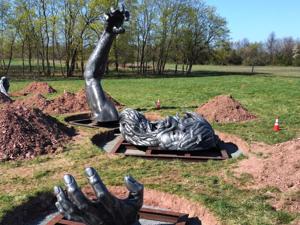

Sometimes news stories can’t help but become personal due to a concept Swiss psychologist Carl Jung called synchronicity– a term which recognizes that two or more events can align seemingly by coincidence.
Such is the case for this writer, as the Hopewell Valley Arts Council prepares to embark on a celebration of the life and art of sculptor J. Seward Johnson, who died in March 2020 at the age of 89.
The six-month celebration begins with an opening ceremony on Sunday, May 21, at D&R Greenway’s St. Michaels Preserve, and will take place around one of my favorite Johnson sculptures, “The Awakening.” The event, sponsored by the Hopewell Valley Arts Council and The Seward Johnson Atelier–in conjunction with D&R Greenway Land Trust and the artist’s family–begins at 11 a.m..
In an interview, Carol Lipson, executive director for the Hopewell Valley Arts Council, said she always wondered why Seward Johnson’s work was never displayed in the town where he lived. That wondering led to the idea of holding a celebration of the artist’s life and work.
It took a year for Lipson and Lynn DeClemente Losavio, program officer for the Johnson Atelier, to design a plan. During that time, they reached out to Linda Mead, the Executive Director of the D&R Greenway Land Trust, who received permission from her board to host the sculpture. The installation has been funded by a grant to The Johnson Atelier from the Atlantic Foundation, a Johnson family foundation.
“Through this public art project, we are honoring the legacy of Seward,” Lipson said.
Lipson called The Awakening “a testament to Johnson’s creative thinking.”
According to the Smithsonian’s Art Inventories Catalog, the first edition of the sculpture was cast in five parts over a two-year period. Depending how the sculpture is positioned, “The Awakening” is 70 to 72 feet long; the aluminum sculpture’s five parts include a left hand, a 17-foot-long outstretched right arm with hand — the tallest point of the statue — a right foot, a left leg with bent knee, and a head with beard and mustache, and an open mouth which could emit loud grunts as this buried man tries to emerge from the earth.
This edition was installed in Washington, for the June 1980 International Sculpture Conference. Johnson’s statue used to sit on Hains Point, a spit of land which juts into the Potomac River in southwest D.C., near Reagan National Airport. While living in D.C., I often enjoyed sitting with the grandeur of the giant.
In 1989, Johnson told a Washington Post reporter that every cab driver would tell him how they took people to see his sculpture. There are five editions of The Awakening according to Emma Vitello, an Associate Curator at the Seward Johnson Atelier. The original one, which used to sit at Hains Point is now located at the National Harbor in Oxon Hill, Maryland. That giant now emerges from sand.
The second edition sits along the Missouri River in Chesterfield, Missouri. The third and fourth editions can be found at the Grounds for Sculpture in Hamilton, and now in Hopewell. The fifth edition, done in fiberglass, is located in Viterbo. Italy.
The Hopewell giant came out of storage from the Seward Johnson Atelier. Atelier staff surveyed the preserve site with laser technology to establish where the giant would be placed.
Then crews dug out five strategic locations, laying down a layer of crushed stone. The five aluminum body parts arrived on three flatbeds and remained strapped down while steel I-beams were set on the stones. Once in place, the sculptures were laid down and secured to the I-beam structure. The piece was then backfilled with the original soil.
Lipson said the statue will remain at the preserve for a minimum of 18 months. She noted that there has been pushback from some community members who find the giant unappealing.
Johnson discussed “The Awakening” in a 2014 interview for a book titled: “Seward Johnson: A Life in Public Art.”
“I created the piece for one main reason–to elicit a sense of wonder in its viewers. They are left to imagine in awe what the giant would look like if he stood up in front of them,” he said.
Johnson wanted people to interact with his art. In a second interview about “The Awakening,” Johnson chuckled: “It’s fun for kids to get into his mouth.”
During a 2003 trip to Washington, my husband and I took our daughters to see the statue. I have pictures of our youngest standing next to the giant’s foot. She was so taken with that sculpture that she wrote Johnson a letter about her adventure and sent him a photo. I have no memory of what she wrote to him. But the letter Johnson’s secretary sent in reply is in a scrapbook.
Dear Mei,
Thank you for your letter and that cute picture of you and my giant’s foot. I hope you didn’t try to tickle it, as sometimes he gets quite nasty.
I loved hearing from you.
Imagine the joy of an 8-year-old child receiving a letter like this; especially an 8-year-old child who loved art.
Fast-forward 20 years, and the 8-year-old is now a self-directed artist/photographer, and a FAA-licensed drone pilot. She emailed Carol Lipson, asking if she could take drone photos of The Awakening for the Arts Council.
Lipson replied: “We were planning to have some drone footage taken at the opening ceremony! And now, here you are!! I love your connection to sculpture.”
* * *
The synchronicity didn’t end there.
The grounds where the giant sits —St. Michaels Farm Preserve — was once the site of what was initially named St. Michaels Orphan Asylum and Industrial School, later called St. Michaels Orphanage. Owned by the Trenton Catholic diocese; and run by the Sisters of St. Francis; the institution was erected on the site of a 400-acre Hopewell farm once owned by Peter Vandyke.
Opening in 1897 and closing in 1973, there are still area residents who spent time at the facility as children. After the closure, the diocese wanted to sell the property to developers. Hopewell residents opposed the move.
A 2017 Trenton Times article reported that in late 2005, the diocese approached D&R Greenway, telling the nonprofit that if it could raise $11M by 2007, it would sell the 400+ acres to D&R for Open Space.
D&R Greenway took ownership of the property in January 2010. At the time, 20 acres were reserved for a possible parish center near St. Alphonsus Church; but D&R acquired that remaining land in 2017.
In a 2016 presentation titled “A Home in the Country,” Hopewell historian Jack Koeppel said the orphanage was built to address a need. The diocese recognized many families were in crisis and could no longer take care of their children. Koeppel noted in 1900, there were 1,000 orphanages in the United States taking care of the needs of more than 100,000 children.
We have had many conversations in our house about children who, for whatever reason, couldn’t stay with the people who brought them into the world. My daughter was born in China, coming home to America at the age of four months.
We eschewed emotionally-laden words like orphan and adopted because they are short-term identities that, while potentially impacting one’s life, shouldn’t be allowed to define one’s life. But we know all too well how these stories can end, in an awakening not of a child’s doing. There is often life-long pain for people who faced these realities as children–especially older children who knew one life and were thrust into another one, not by choice. Recently walking the grounds was emotional for me.
Seward Johnson, we should suspect, would approve of the Hopewell location, which allows easy access for community members. In a 2000 interview with a reporter, he said: “I want people who look at my sculpture to experience joy. It’s fun.” In that same interview, the artist said his work needed “people to react with it — they complete the sculpture.”
* * *
If fundraising is successful, Lipson said, 14 of Johnson’s life-sized sculptures will be installed throughout Hopewell Valley for a six-month period. Statues would even be located at schools in the Hopewell Valley Regional School district. As an artist, Johnson believed public sculpture was “art for actual people.”
Johnson infused his work with his sense of fun and whimsy — something art critics must have missed. In 2003, Washington Post art critic Blake Gopnik called an exhibition of Johnson’s work “hideous and dumb.” The statues Gopnik disliked are now at the Grounds For Sculpture, where people delight in having their pictures taken alongside those very statues.
Admirers, on the other hand, called Johnson a mischief maker. In a retrospective video presentation of Johnson’s life, viewers learn his grandchildren “appointed him president of the Naughty Club.” He was a Shakespearean Puck for our times, and we are richer for his vision.
* * *
An opening ceremony for The Awakening will be held on Sunday, May 21 from 11 a.m. to 1 p.m. at D&R Greenway’s St. Michaels Farm Preserve. Members of the community are invited to attend a celebration that will include dance, poetry, and music.
“This project celebrates Seward’s spirit,” said DeClemente Losavio. “He loved Hopewell Valley — the beautiful expanse of field and forest of St. Michaels Farm Preserve, a sense of well being and return to nature. He would have loved people wandering, wondering, and finding their own story as they enjoy the surrounding trails and community. The giant really amplifies this feeling."