
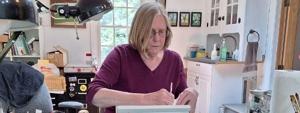

Karen Wilbert-Keppel is an artist who works on her art every day, as artists are supposed to. She draws and paints a multitude of subject matter. She is a former art teacher who is skilled at all of the facets of art making.
One discipline she taught and still practices is making books by hand binding. It is a skill by which very beautiful books are made. Her books are a way to showcase her paintings.
Karen is now retired. She meets weekly with fellow artists in her studio, and they make art together for the love of it.
When did you begin in the arts?
I have always loved art and knew that it would always be a part of my life. I became an art teacher and had a rewarding career teaching in the New Jersey Correctional system for many years. I taught at Trenton State Prison, Garden State Youth Correctional Facility and Skillman Training Center. I had small classes of about five.
It was very interesting teaching those who were incarcerated. These people had all day to work on their art. They became very good. They would paint landscapes, cityscapes and figures. I learned as much from them as they did from me. Now, in retirement, I spend a large part of each day in my studio.
Which media do you work in?
I started with oils, but now I use all sorts of media: gouache, Artgraf (watercolor graphite), watercolor, acrylic paint, acrylic ink, gel printing and anything else I care to experiment with. I create handmade books both as an art form and for sketchbooks, and many of the media techniques are used in that process.
Which media is the most difficult to work in?
Watercolor certainly, but the transition from oils to acrylics has been a bit of a relearning process. I do use watercolor to color ink drawings on paper.
Which media do you most enjoy?
I find a great pleasure in creating a handmade book. From the creation of the cover with its various forms of artwork and design to the layout and sewing of the pages. I love using all the tools (bonefolder, piercing cradle, sewing frame, and awl) that help make the book come together. It’s a very satisfying process.
Gouache has become my go to medium for painting. When I paint miniatures, the fast-drying process, and the ability to paint over and layer, works very well for me.
Who are some of your inspirations or influences?
Mel Leipzig, the retired professor from Mercer County Community College, who in class, would tell us that you must pick up a brush every day. He is an amazing artist who has continued to do that throughout his entire life. I try to attend as many of his lectures as I can because fifty years later, he is still so inspiring.
One of my early influences was Van Gogh and a current favorite is Maud Lewis a painter from Nova Scotia. I love the seemingly simplicity of her work.
Where did you study art?
Mercer County Community College— Associate of Fine Arts; Trenton State College (The College of New Jersey)—a bachelors degree in art therapy and art education; from Hahnemann Medical College— a master’s degree in creative art therapy.
Which are your favorite art museums or venues?
Local art exhibits are my favorite. I enjoy attending yearly events such as the Ellarslie Open, Covered Bridge Open Studios, Phillips’ Mill and assorted galleries.
What fight/struggle do you have regarding your art?
Fortunately, I have a beautiful little studio that I spend time in every day. Retirement has enabled me to find the artist in me again, and I am content with creating for the pleasure of it.
Do you still meet with an artmaking group?
I no longer run the artmaking group, but I regularly meet individually with friends and family members for assorted art activities. My dearest friend and I have been meeting for 13 years or so to do bookbinding projects, painting and experimenting with all types of media.
What are you working on now?
For 12 years, I have maintained a 365-day art regimen where I do some type of art every single day documenting it in multiple sketchbooks. This year I divided a large piece of watercolor paper into little squares roughly one and a quarter inch and do a tiny painting or drawing daily. The paper has been cut and folded to make a “snake” book to make it easier to manage.
What is on the horizon? What are you looking forward to?
I am coordinating a small group of friends who will meet regularly for plein air, outdoor, onsite, painting and sketching. Typically, I paint from my photographs, but I want to get better at painting from moment.