

When Robbinsville native Nathan Oliva set out to make his senior thesis film at the Savannah College of Art and Design (SCAD), he didn’t plan on following lions through the South African bush.
But one conversation changed everything — a friend in Cape Town mentioned that her father ran a wildlife sanctuary where rescued lions roamed free.
Within weeks, Oliva was on a plane, camera in hand, ready to capture a story that would alter the course of his young career.
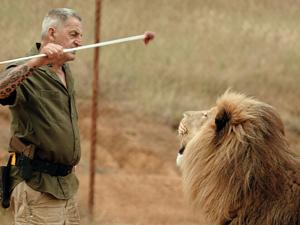
The resulting short documentary, Cornellskop: Freedom From Fear, introduces viewers to the world of Luke Cornell, founder of the Cornellskop Animal Sanctuary in Bot River, South Africa.
Set against the rugged beauty of the Van der Stel Pass Valley, the film exposes the brutal realities of South Africa’s captive-bred lion industry — animals raised for tourism and trophy hunts, then killed and sold into the global bone trade.
Oliva captures Cornell’s resolve and tells a story of resilience and redemption that unfolds far from the spotlight. Shot over six days in November 2024, the film combines sweeping cinematography with intimate interviews.
A small team of South African collaborators — including cinematographers Mike Faraday and Matthew Alexander, and producer Dixie Cornell — helped Oliva capture the connection between humans and animals. Their lens work turns the sanctuary itself into a character: vast, sun-drenched, and filled with both tension and hope.
Narration by actor Peter Coyote, the Emmy-winning voice behind Ken Burns’ The Vietnam War and The Roosevelts, helped to lend the project a sense of authority and warmth.
Drawn to the film’s message of ethical stewardship, Coyote joined the production to amplify its call for awareness. His voice guides viewers through Cornell’s daily life — walking among lions, tending to rescues and confronting the lingering scars of an industry that profits from cruelty.
The film’s authenticity owes much to the bonds Oliva formed in South Africa. Supported by Sony Alpha South Africa, the crew relied on lightweight FX6 and FX3 cameras to navigate the unpredictable challenges of working with wildlife.
Their collaboration blurred the lines between work and friendship, resulting in a film that feels both cinematic and deeply personal — a tribute to teamwork and shared purpose.
Since its completion in April 2025, Cornellskop: Freedom From Fear has already found success on the festival circuit, earning Best Documentary Short Film honors at the Hamilton NY International Film Festival.
It was also screened at the NYC Short Doc Festival, the South Africa Indie Film Festival, and the 2025 SCAD Savannah Film Festival.
The Robbinsville Advance recently conducted an e-mail interview with Oliva about his journey from local student to international filmmaker, his time at the Savannah College of Art and Design, and the message behind Cornellskop: Freedom From Fear. His responses appear in the Q&A below, which has been lightly edited.
Why did you choose Cornellskop Animal Sanctuary as the centerpiece of your film?
I was first introduced to the Cornellskop Animal Sanctuary while working with Moonsport TV during the summer of 2024 in Cape Town, South Africa. While I was filming a documentary about a rugby tournament, my good friend and the producer of the project, Dixie Cornell, told me about her dad’s farm, Luke Cornell’s sanctuary with lions and other wildlife.
From the moment I toured the sanctuary, I was struck not only by the incredible animals, but by the deep, familial bond each one shared with Luke. I watched him walk side by side with his lion pride and learned about the sanctuary’s beginnings and the harsh reality of canned hunting in South Africa. With his powerful presence and genuine love for the animals, Luke immediately established himself as an extraordinary subject for the documentary.
How did your time at the Savannah College of Art and Design influence this project?
I couldn’t be more grateful for the people I’ve met at SCAD and the professors who have always had my back, along with my team’s. We built a dream team of friends and collaborators who share the same vision and drive to create incredible work. SCAD has this intense, immersive environment that naturally pushes you to form close bonds with your teammates.
Countless late nights and hours spent on collaborative projects reveal who you really work well with and everyone is willing to go the extra mile to bring a vision to life. Beyond the friendships and teamwork, SCAD taught me to approach storytelling with both ambition and care. Every project is a lesson in problem-solving, creativity, and trusting your instincts, even when things get complicated.
Professor Christopher Brannan was an incredible mentor throughout the process, always supporting our ideas while guiding us with his expertise whenever we felt stuck. My time at SCAD taught me not just how to make a project, but how to build a team that can turn ambitious ideas into reality.
Can you describe the experience of working with your team of friends on the project?
On location in South Africa, we had an incredibly small but dedicated team of just four friends. The two Cinematographers, Mike Faraday and Matt Alexander, are my close friends who live and work in Cape Town.
With their quick thinking and cinematic expertise, we were able to capture the stunning landscape and truly do it justice on screen. My good friend Jeremy Ryall, a talented director also based in Cape Town, joined us for a few days to offer his insights, adding another layer of creative perspective.
We were also fortunate to have our producer, Dixie Cornell, ensuring production ran smoothly, both on and off set while allowing the rest of the team to focus on the creative work.
I am incredibly thankful to my friends in South Africa who made this project possible. Working with this team is not only highly effective but genuinely enjoyable, and I can’t wait to see what we create together on our next project.
How did you secure Peter Coyote as the narrator, and what do you feel his voice added to the film?
The producer of the project, Jack Bart, reached out to Peter Coyote, who has extensive experience narrating documentaries, most notably through his longtime collaborations with Ken Burns. As a wildlife activist himself, Peter was immediately drawn to the story of Cornellskop and was happy to lend his voice to the project.
He was eager not only to support a student-led film, but also to be part of a message he deeply believes in. His distinctive voice brings a level of professionalism, warmth, and authority that elevates the story and gives the film that extra layer of credibility and depth.
What role do you think filmmakers can play in sparking conversations about wildlife protection?
I think filmmakers have a unique ability to bridge the gap between people and the parts of the world they may never experience firsthand. Growing up, I would go see the Disneynature movies in theaters with my family and be amazed by the incredible animals, people, and cultures I was seeing.
I wanted to experience that, but even more, I wanted to bring it to others who might never get the chance. When you show real stories and honest moments between humans and animals, you make people care in a way that statistics or articles can’t. Film has the power to create empathy.
You can watch a story unfold and suddenly feel connected to something happening on the other side of the planet. For me, it’s not about preaching or trying to tell people what to think. It’s about showing something real and letting the audience feel it for themselves. If a film can make someone stop and think, even for a moment, about the importance of protecting wildlife, then it’s already done its job.
How does winning “Best Documentary Short Film” at the Hamilton NY International Film Festival shape your expectations for future screenings?
Winning was incredible validation for our team, as it was our first festival and we couldn’t have asked for a better outcome. It shows that our storytelling resonated, and that audiences and juries saw merit in our work.
I also feel more responsibility: because the film has that award behind it, people will come in with expectations. So, I want to deliver every time, bringing that same care, authenticity, and craft to every screening or presentation as well as myself and the team’s future work together.
What kind of international response do you hope the film receives?
What I really hope for is connection. This story comes from a specific place in South Africa, but the themes of compassion, responsibility, and the relationship between humans and animals are universal.
If audiences in completely different parts of the world can feel something from it, whether that’s curiosity, empathy, or even just awareness, then that’s a huge success to me.
Do you plan to continue making films on conservation and wildlife, or do you see yourself branching into other topics?
Absolutely. Wildlife and culture will always be close to what drives me as a filmmaker, but I am also drawn to stories that explore the moral and cultural complexities of how humans interact with animals.
My next project looks into the world of Spanish bullfighting, exploring Spain’s bullfighting world, capturing the culture, controversy, and the lives shaped by this ancient ritual. Through the voices of matadors, breeders, and lifelong fans, the film explores why this ritual still holds meaning for so many people and what happens when centuries of heritage come face to face with evolving ethics.
What advice would you give to young filmmakers who want to combine storytelling with advocacy?
Honestly, I’m at the beginning of all this and figuring things out as I go. What’s helped me most is working with people who are really strong in their own crafts and balance out what I bring to the table. When everyone leans into what they do best, it creates this natural rhythm where great work just happens. When you build a team like that, people who care about the story and about making something meaningful, you naturally find yourself in situations where great work can happen.
If you want to combine storytelling with advocacy, start by caring deeply about what you’re filming and the people you’re filming with. Don’t wait to feel ready. Just start making things, learn from the process, and let your passion guide you toward the stories that matter.
What did your parents do for a living, and did they influence your career decisions?
Neither of my parents work in fields related to film, but they’ve always fully supported what I do and the decisions I make. Even the ones that might seem questionable at first. They’ve always had my back, and I’m really thankful for that.
Were there any teachers, mentors, or experiences at Robbinsville High School that encouraged your path toward filmmaking?
At Robbinsville High School, the biggest influence on my journey toward filmmaking was the Dual Enrollment program with Mercer County Community College. Through this program, I was able to spend the second half of each school day taking college-level film courses alongside college students, all while still in high school. Every class I completed transferred to SCAD, allowing me to graduate an entire year early. More importantly, those courses gave me an early foundation in filmmaking concepts and techniques, helping me shape my creative style and develop a clear sense of the kind of filmmaker I wanted to become.
When you think back to being a student in Robbinsville, did you ever imagine your work would be screened at festivals alongside famous names like Rian Johnson, Mark Hamill and Jennifer Lopez?
Not at all. It wasn’t until I got to SCAD that I realized how within reach it actually was. The school has the resources, the connections and professors who know the industry inside and out. It really just comes down to putting in the work and taking advantage of what’s in front of you.
From there, it started to feel less like a dream and more like something that my team and I could make happen. It made me take my work more seriously, but also appreciated the process, the trial and error, the small wins, and the moments when something finally clicks.
Seeing my film play alongside those kinds of names isn’t just significant because of the names, but it feels like proof that the effort, the late nights, and the learning actually led somewhere. It makes me want to keep pushing, not to chase names, but to keep leveling up what I make and how I tell stories.
I’m incredibly grateful to my professor, Kevin McCarey, a director at National Geographic for over 20 years, for mentoring me and I’m equally thankful to my friends and collaborators at SCAD like Jack Bart and Grace Lavery. This was a team effort, and they brought skills and ideas to the project that I could never have accomplished on my own.
How do you hope your story might inspire young people in town who are considering creative careers?
I’d tell them to just go do it. Don’t be afraid to leave for a while and get some perspective. You have to see how people live, create, and think in different parts of the world because that’s where your voice really starts to take shape.
Learn as much as you can, make mistakes, stay up way too late working on things you love, and be completely obsessed with getting better. If you do that, even a small-town start can turn into something way bigger than you imagined.
When I left Robbinsville, I didn’t really know what I was chasing. Meeting people from all over showed me how many ways there are to see the world, and that changed how I tell stories. It keeps me curious, and that curiosity is what drives me more than anything. I’m really thankful for SCAD and everyone there who helped shape how I work.
The professors and friends I’ve met made the hard parts of filmmaking feel worth it. They pushed me, gave honest feedback, and made it feel like I wasn’t doing this alone. That’s what made the difference for me.