

Three things are certain.
Death, taxes, and a proliferation of adaptations of Charles Dickens’ “A Christmas Carol.”
These come in all forms, ranging from one-person recitations to spoofs and poignant renderings of Dickens’ timeless tale of redemption.
For 45 years, in versions written by Nagel Jackson, David Thompson, and now, Lauren Keating, Princeton’s McCarter Theatre has leaned towards a faithful, dramatic telling of how miserable, miserly Ebenezer Scrooge learned to “accept Christmas in his heart.”
For 45 years Princeton’s McCarter has been the place to be to see a work that moves, entertains, and does credit to both McCarter, its writers, and director.
2025 is no different. Lauren Keating, as playwright and director, has tweaked the winning adaptation she unveiled three seasons back, giving the ghosts of Christmas past and present a little more edge and endowing the young Scrooge of the Fezziwig years (Ian Coulter-Buford) with extra personality and Christmas spirit that creates a greater contrast than usual between the lively, sensitive youth that was and the curmudgeon whom ghosts, including Scrooge’s longtime partner, Jacob Marley, are called in to change.
Both tweaks, and others, work. They don’t necessarily improve Keating’s stagings from Christmases past, but they extend a tradition of thoughtful, high-quality, polished renditions of “A Christmas Carol” at McCarter.
Keating’s 2025 adaptation is warm and funny in turns, chooses the best sequences to make Scrooge’s Christmas Eve odyssey poignant and joyful, and incorporates dances by Emily Maltby and carols that enhance Dickens’ narrative and bring a wistful touch of Victorian London, the one you feel when you visit Dickens’ house on Doughty Street, to the McCarter stage.
Keating and her cast do charming work. One can know Dickens’ story as well as its solo reciters, and Keating’s production will bring it to fresh, vibrant life that holds interest and compels you to want to see how the piece you know so well unfolds. It makes you wish there were more sequences from Scrooge’s past and present for the ghosts to reveal.
It also extends a couple of other traditions, and not just the looming shadow of St. Paul’s cathedral that dominates the Matthews stage’s stage left wall. The traditions I mean are the reprise performances of Gina Daniels as Old Jo and Maria Habeeb as Scrooge’s fiancee, Belle.
Keating expands Old Jo’s role in “A Christmas Carol” by giving the shrewd, cynical pawnbroker of Dickens a benevolent purpose at the beginning of her play. Jo, rather than being confined to a musty old shop where the hopeful get less than they expect for the treasures they turn over, wheels a cart of goods, new and old, through East London and treats people who are struggling or unable to plausibly afford to the gifts they know will please their loved ones.
It’s one more contrast between the stingy, withholding Scrooge and a businessperson who revels in making friends happy whether profit is lost or not.
Year after year, Gina Daniels exudes the generosity Keating gives Jo while keeping the “rings and all” scene as chilling as it’s intended to be.
Maria Habeeb presides effectively over the happy and the heartbreaking, being as merry as a Fezziwig Christmas party when she does her first “Wassail” dance with Scrooge and resigned and resolute when Belle realizes she can no longer compete with Scrooge’s counting house for his loyalty and attention.
The scene in which Belle returns Ebenezer’s engagement ring is particularly affecting this year because Habeeb is a charming, life-enhancing Belle, and Ian Coulter-Buford is a Scrooge whose love for Belle shows explicitly, who is such an avid partygoer, dancer, and admirer of Fezziweg’s conviviality, and who looks genuinely surprised and momentarily crestfallen when Belle ends their relationship.
Coulter-Buford’s initial esprit and penchant for balancing fun and responsibility truly makes Scrooge’s conversion to a businessman and only a businessman who concentrates only on his business sadder and more pitiable than an upsetting literary device.
Jayda Knowles, who plays Scrooge as a child, also has a stoic sensibility and knack for having fun despite family hardship that puts Scrooge’s misanthropy in sharper perspective.
Daniels, Habeeb, Coulter-Buford as both the youthful Ebenezer and Scrooge’s orphaned nephew, Fred, and others such as Elizabeth Reese’s Mrs. Dilber, Carlos L. Encinias’s Cratchet, Vivia Font’s Mrs. Cratchit, and Caryna Desai Shah as Tiny Tim contribute to the reality, coziness, and impact of Keating’s production.
The pronounced isolating of the young Jacob Marley as anti-social and obsessed with money and joyless order is another touch that makes Keating’s staging stronger.
Grayson DeJesus plays Marley with a perpetual sneer that broadcasts contempt for any merrymakers or anyone who sacrifices cold, single-minded business to even a moment of fun or frivolity.
DeJesus is directed to be the primary villain and hardener of Scrooge, and he fulfills that role with both subtlety and openly expressed disdain for anything that resembles a lively good time.
DeJesus is, as would be expected, more contrite and intent on making his warning pay when Marley’s dead-as-a-doornail ghost visits Scrooge and begins Scrooge’s examination of his life.
Coyly weaving in all Coulter-Buford and Knowles did before him while establishing his own tone of haughty superiority and quick, flippant response, Cameron Knight is a multi-faceted Scrooge.
Especially in his constant denial of all the ghosts of Marley, Christmas Past, and Christmas Present, have shown him. After responding and even participating with enthusiasm and honest sentiment to the visions he’s shown, Knight’s Scrooge summarily dismisses the verifiability of those images once the ghosts are gone.
He is totally affected only when the silent Ghost of Christmas Yet to Come can’t and doesn’t answer him about whether anything present or future is changeable.
Knight is a master at transitions. Just as the younger versions of himself frolic with boys playing soccer or dancers at the Fezziwig, Knight’s witnessing Scrooge wants to join in the fun, only to be as grim and doubting as ever when he is securely back in his bedroom following a ghost-guided sojourn.
When Scrooge’s encounter with the Christmas Yet to Come forces a revelation and gives him the idea he can change present and future, Knight jumps completely into his new role, showing a gusto and guile that indicates he has regained some sense of fun and wants to be part of the common merriment the ghosts let him see as they passed his life before him.
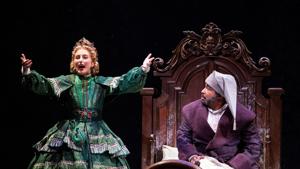
As for the ghosts, Keating directed them to be more impatient this year than they’ve been portrayed in the past. Royer Bockus no longer enters ebulliently with an irrepressible ho-ho-ho and tinsel everywhere to begin Scrooge’s tour of Christmas present. She rousts Scrooge from his denial of her predecessor, Christmas Past, and glares at him as he sees for the first time the plight of Tiny Tim or takes offense at the way guests at his nephew’s party refer to him during a game of “Yes and No.”
Bockus, as well as being businesslike, has cute moments when she uses some silvery sparkles to enhance Mrs. Cratchit’s pudding.
Sophia Alawi also blends some sarcasm, particularly when she quotes some of Scrooge’s more unfriendly comments, and interest in Scrooge’s reaction when she shows him his past.
Carlos L. Encinias is as steady-going and content a Bob Cratchit as I’ve ever seen. He seems to take his life with a shrug, accepting his lot as the employee of a cantankerous, temperamental man and coping with the likely terminal illness of his son, Tiny Tim, yet reveals the angst and sadness underneath.
Encinitas’ Cratchit is both benign and deep, naive yet stoic. It’s an interesting and satisfying portrayal that opts for a grin instead of a cringe when Scrooge barks and care and appreciation in place of overt worry in parenting Tiny Tim.
Caryna Desai Shah is a Tiny Tim you think must survive. Shah makes Tim remarkable in seeming to share his father’s leveling stoicism and being an altogether bright, articulate child.
Daniel Ostling’s set captures the many facets of London while neatly becoming Scrooge’s counting house, Fred’s apartment, or the Cratchits’ cottage. Linda Cho does a fine job with costumes, especially with her green dress, both Victorianly prim and festive for Christmas Present. Paul M. Kilsdonk’s lighting makes Christmas yet to come appropriately bleak while capturing the brightness of the Fezziwig ball and the various stages of night when the ghosts appear. Palmer Hefferan’s sound design goes effectively from echoes and reverberation to the perfect level for the lovely, harmonizing chorus.
A Christmas Carol, McCarter Theatre, 91 University Place, Princeton. Through Sunday, December 28. Showtimes are 7:30 p.m. Tuesday through Friday and 1 and 5:30 p.m. on Saturday and Sunday. $35 to $115. www.mccarter.org or 609-258-2787.